

From JD Vance’s striking End Times remarks to President Trump’s rejection of “global government” at the United Nations, subjects once largely confined to prophecy conferences and Bible studies are moving into mainstream conversations about politics, technology and the future of civilization.

🎉📖Discover Troy Anderson’s Inspiring Book Collection🎉📖
Prophecy Investigators is a reader-supported publication. If you enjoy our articles and videos, please consider becoming a paid subscriber. You will receive access to read in-depth articles, watch exclusive interviews, and partner in our mission to spread the Good News of Jesus Christ.
For generations, discussions about the Antichrist, global government and the technological infrastructure that might someday make the economic controls described in Revelation possible were largely found in churches, Bible studies, prophecy conferences and Christian books.
Something is changing.
In recent weeks, Vice President JD Vance has publicly discussed whether the Antichrist could already be alive, raised spiritual concerns about certain uses of artificial intelligence and described experiencing what he regarded as spiritual darkness in meetings with world leaders. President Donald Trump, meanwhile, stood before the United Nations on September 22 and declared, “There is no global government — and while I am President, there will be no global taxes.” He also rejected what he called an attempt to construct a “globalist scheme of control” for artificial intelligence.
These statements do not establish that biblical prophecy is being fulfilled, nor do they prove that the world has entered a particular prophetic timetable. But from an investigative perspective, they reveal a significant cultural development: language about the Antichrist, spiritual warfare, artificial intelligence and global governance is increasingly entering mainstream political and public discussion.
For Prophecy Investigators, the question is not whether every headline should be labeled prophecy. The question is more careful — and potentially more consequential:
Why are these themes emerging now, and what happens when we examine them alongside the warnings of the Bible?
JD Vance: “Not Shocked if the Antichrist Was Walking Among Us”
Vice President JD Vance entered unusually explicit theological territory during a recent conversation with Christian podcaster Bryce Crawford. Asked about the End Times, Vance did not claim to know that they had arrived. In fact, he cautioned against becoming consumed by such speculation.
“Do I think we are in the end times? I don’t know,” Vance said, while warning against focusing too heavily on the question. Yet he went on to say that there are “things about the world” that would leave him “not shocked if the Antichrist was walking among us.”
That distinction matters. Vance did not say that he knows the Antichrist is alive, nor did he claim that current events prove the End Times have arrived.
What makes the exchange noteworthy is that a sitting vice president is publicly discussing these subjects at all — and connecting some of those concerns to the technological revolution now reshaping society.
Vance also described occasions when meetings with world leaders had triggered what he characterized as spiritual warning signs. He recalled situations in which something said during a meeting would cause him to “feel some darkness” and set off “every spiritual alarm bell” in his body. He also described experiencing what he called “a very dark spiritual energy” at Gettysburg.
Artificial intelligence entered the conversation as well. Vance pointed to the growing use of AI as a substitute for human interaction, including an acquaintance who had used AI as a marriage counselor. When Crawford characterized that idea as “kind of satanic,” Vance responded that completely divorcing human beings from the social relationships for which he believes God created them is “very bad.”
The implications extend beyond theology. AI is already at the center of debates over employment, national security, surveillance, misinformation, warfare, privacy and human relationships. Vance’s remarks introduce another question into that rapidly expanding debate:
Can technological development also raise spiritual and moral questions about what it means to be human?
Discover Trump vs. the Beast
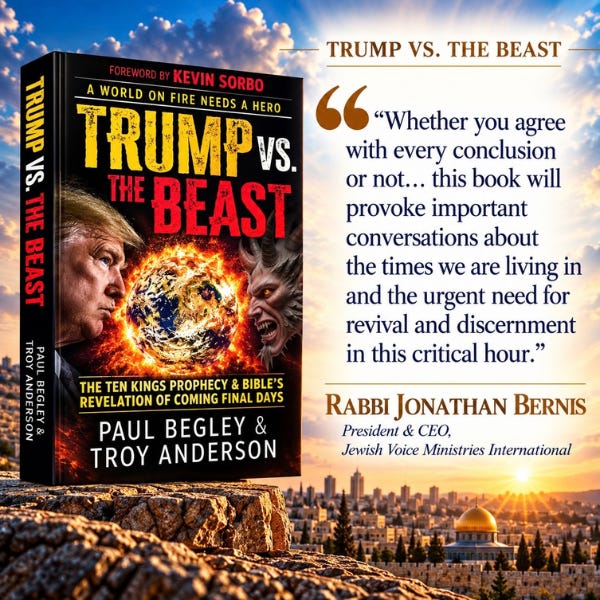
What do the ancient prophecies of Revelation reveal about the Ten Kings, the Antichrist, global power and the extraordinary technological changes reshaping our world? In Trump vs. the Beast: The Ten Kings Prophecy and the Bible’s Revelation of Coming Final Days (Humanix Books/Newsmax Media, October 6, 2026), the #1 “Hot New Release” in “Prophecies” on Amazon, Pastor Paul Begley and I (Troy Anderson) investigate these questions alongside artificial intelligence, digital systems, geopolitics and the biblical warnings surrounding the final days.
Explore the investigation, endorsements and the prophetic questions at the heart of Trump vs. the Beast. EXPLORE TRUMP VS. THE BEAST →
Trump at the United Nations: “There Is No Global Government”
Three weeks after Vance’s remarks drew attention, President Donald Trump brought another dimension to the conversation—this time focusing on national sovereignty, international institutions and the future governance of artificial intelligence.
Addressing the 81st United Nations General Assembly on September 22, Trump criticized a proposed international carbon-related levy on shipping and used the issue to make a broader declaration about global governance:
“There is no global government. And while I’m president, there will be no global taxes.”
The statement was part of Trump’s broader argument that international institutions should not override U.S. sovereignty. His administration has separately directed U.S. withdrawal from numerous international organizations and entities it determined were contrary to American interests. Read the transcript of Trump’s speech at: Roll Call
Trump then turned directly to artificial intelligence, declaring:
“The United States also totally rejects any attempt to construct a globalist scheme to control” artificial intelligence.
During the same address, Trump said his administration would begin referring to AI as “super intelligence,” or “SI,” arguing that the word “artificial” inaccurately suggests that the technology is somehow unreal. His rejection of international AI control came amid a broader global debate over how governments should regulate increasingly powerful AI systems. Find out more at: Miller Center
These were political and policy statements—not declarations about Bible prophecy. Trump did not claim that global institutions represent the Beast system described in Revelation, nor did he connect his remarks to the Antichrist.
Nevertheless, for researchers of biblical prophecy, the terminology intersects with a centuries-old theological debate concerning the concentration of political and economic authority described in the books of Daniel and Revelation.
That distinction is crucial. International cooperation is not synonymous with the Beast system, and the existence of global institutions does not establish prophetic fulfillment. At the same time, the extraordinary expansion of interconnected financial networks, digital identification, artificial intelligence and surveillance technologies raises questions that previous generations of prophecy scholars could address largely in theory.
Today, some of the technological capabilities involved in those discussions are no longer theoretical.
That is where the investigation becomes especially significant: not whether today’s institutions can simply be labeled as fulfillment of Revelation, but whether technologies and governance structures are emerging that could someday make unprecedented forms of centralized identification, surveillance and economic control possible.
Discover Revelation 911
What happens when ancient biblical prophecy collides with the headlines of our time? In the #1 bestseller Revelation 911: How the Book of Revelation Intersects with Today’s Headlines (Salem Books/Regnery Publishing), Pastor Paul Begley and I (Troy Anderson) investigate the intersection of Bible prophecy, geopolitics, cultural upheaval and rapidly changing world events, examining the spiritual questions behind developments reshaping our generation.
Go deeper into the investigation and discover what Scripture may reveal about the extraordinary times in which we are living. EXPLORE REVELATION 911 ON AMAZON →
Silicon Valley Is Talking About the Antichrist, Too
The conversation is not limited to Washington. Remarkably, questions about the Antichrist, artificial intelligence and global power have also surfaced inside Silicon Valley, where some of the technologies transforming civilization are being financed and developed.
Billionaire technology investor Peter Thiel has devoted considerable attention to these subjects. In a series of private lectures delivered in San Francisco in 2025, Thiel explored the Antichrist, technological development, political power and the possibility of a centralized global state. Recordings of the lectures were later obtained and reviewed by The Washington Post, while Reuters separately reported on Thiel’s arguments.
Thiel’s interpretation is particularly noteworthy because it differs from a common assumption in some Christian prophecy circles. Rather than simply portraying advanced technology or AI itself as the principal danger, Thiel has warned that fear of technological catastrophe—including fears surrounding artificial intelligence and nuclear war—could potentially be used to justify increasingly centralized political authority. In his framework, a future authoritarian figure could gain power by promising safety and stability in response to global crises.
His views are controversial and represent Thiel’s own theological and political interpretation, not a consensus Christian understanding of the Antichrist. Indeed, The Washington Post reported that Thiel went so far as to characterize certain critics of technological development as “legionnaires of the Antichrist,” illustrating how dramatically his interpretation can diverge from more familiar evangelical End Times frameworks.
The larger cultural phenomenon, however, is difficult to overlook.
A vice president is publicly discussing the Antichrist and AI. A president is talking about global government and international control of artificial intelligence. And one of Silicon Valley’s most prominent technology investors has devoted hours of lectures to the Antichrist, technological development and centralized global authority.
These figures are not necessarily saying the same thing, and their views should not be conflated. But collectively, their remarks illustrate a striking development: the vocabulary of apocalyptic theology is appearing in conversations at unusually high levels of American politics and technology.
For Prophecy Investigators, that raises a question worth examining:
Why now?
Why, at precisely the moment when artificial intelligence is advancing at extraordinary speed, are ancient questions about the Antichrist, centralized power and the future of civilization resurfacing among political leaders and technology figures?
The answer may have less to do with proving that prophecy is being fulfilled than with something more immediately observable: humanity is acquiring technological capabilities that force society to confront questions about power, control, human identity and the future that once belonged largely to the realm of theology and speculation.
And that brings the investigation directly to one of the Bible’s most provocative descriptions of future economic power: Revelation 13.

Discover I’ve Been to Heaven
What happens when prayer, faith and the reality of eternity collide with a life-or-death moment? I’ve Been to Heaven, an ECPA Bestseller and AWSA Memoir of the Year, tells the extraordinary true story of Steve and Kathy Boyls—a husband’s near-death experience, a wife’s faith-filled prayers, and a remarkable message of hope, Heaven and God’s love.
Written with Troy Anderson, this powerful testimony invites readers to consider the reality of the afterlife and the hope found in Jesus Christ.
Discover the remarkable true story that reminds us that Heaven is real—and hope is never lost.
Revelation 13: An Economic System Earlier Generations Could Barely Imagine
One reason the convergence of artificial intelligence, digital identity and increasingly interconnected financial systems attracts the attention of prophecy researchers is a striking passage in Revelation 13.
The Apostle John describes a future system in which the ability to participate in economic life becomes connected to allegiance to the Beast:
“And that no man might buy or sell, save he that had the mark of the beast.”
— Revelation 13:17 (KJV)
For much of Christian history, believers could read those words but could only speculate about how such widespread economic restrictions might actually be implemented. How could the buying and selling of enormous populations be monitored, verified or restricted with precision?
The technological landscape of the 21st century makes that question significantly different. Digital payment networks, biometric authentication, facial recognition, artificial intelligence, digital identity systems and interconnected databases can already authenticate individuals, process transactions and analyze enormous quantities of information at extraordinary speed. These technologies were unavailable—and in many cases almost unimaginable—to earlier generations of Bible interpreters.
That does not mean these technologies constitute the “mark of the beast.” Artificial intelligence is not inherently “the beast.” Biometric identification is not automatically the mark. Digital currencies and electronic payment systems do not, by their mere existence, fulfill Revelation 13.
For Prophecy Investigators, the more precise question is not “Is this the mark of the beast?” but rather: Are technological capabilities emerging that could someday make the kind of identity-linked economic restriction described in Revelation 13 possible on a scale earlier generations could scarcely have imagined?
That is a fundamentally different question—and one that can be investigated without declaring that prophecy has already been fulfilled.
The significance lies in the capability. Technologies now exist that can link identity, authentication and financial activity with remarkable speed and precision. Whether any present or future system should be identified with Revelation 13 is a theological question requiring far more evidence and discernment.
But the technological question is increasingly difficult to dismiss:
For the first time in history, the mechanics of how large-scale, identity-linked restrictions on economic participation might operate are no longer purely theoretical.
That does not prove Revelation 13 is being fulfilled.
It does mean that a scenario earlier generations could barely imagine has become technologically conceivable.
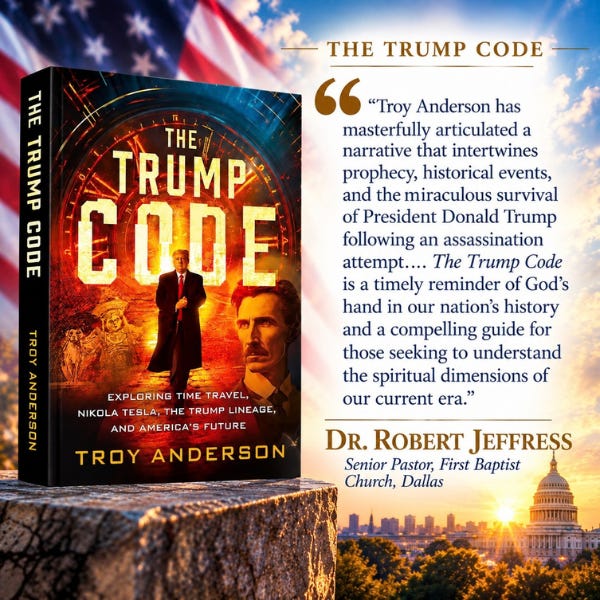
Discover The Trump Code
What happens when history, faith and prophecy converge at a pivotal moment? In the #1 bestseller The Trump Code: Exploring Time Travel, Nikola Tesla, the Trump Lineage, and America’s Future, (Charisma House/FrontLine), Troy Anderson investigates the extraordinary events surrounding Donald Trump through the lens of biblical prophecy, American history and spiritual awakening, exploring the deeper questions behind one of the most consequential eras in modern America.
Drawing connections across history, Scripture and current events, the book invites readers to examine the patterns and prophetic themes shaping our rapidly changing world.
Discover the investigation and the extraordinary story behind The Trump Code.
Revelation 17 and the Mystery of the Ten Kings
If Revelation 13 raises questions about economic power and control, Revelation 17 introduces another dimension of the prophetic mystery: political authority.
The Apostle John describes ten rulers who emerge for a brief period and ultimately align their authority with the Beast:
“And the ten horns which thou sawest are ten kings, which have received no kingdom as yet; but receive power as kings one hour with the beast.”
— Revelation 17:12 (KJV)
The passage continues by describing an extraordinary convergence of authority:
“These have one mind, and shall give their power and strength unto the beast.”
— Revelation 17:13 (KJV)
For centuries, theologians and prophecy scholars have debated the identity and significance of these mysterious “ten kings.” Interpretations have varied widely across different schools of biblical eschatology, and Scripture does not provide a modern geopolitical map identifying today’s nations, political leaders or institutions with the ten rulers.
That uncertainty is important to acknowledge.
What Revelation does present, however, is a picture of political authority becoming aligned for a limited period with the Beast. Revelation 13, meanwhile, describes a system capable of restricting economic participation. Read together, these passages have led generations of prophecy researchers to ask whether political authority, economic power and systems of control could eventually converge in ways that make the prophetic scenario John describes possible.
For most of history, that question remained largely theological and speculative. Today, globalization, artificial intelligence, instantaneous communications, interconnected financial networks and other technologies have created forms of international coordination that previous generations could scarcely have envisioned.
Again, the existence of these systems does not establish that Revelation 17 is being fulfilled, nor does it justify identifying contemporary political leaders, nations or international organizations as the Ten Kings. The investigative question is more disciplined: Are political and technological structures developing that could someday facilitate the kind of rapid concentration and transfer of authority described in Revelation 17?
That mystery lies at the heart of Pastor Paul Begley and I (Troy Anderson’s) forthcoming book, Trump vs. the Beast. Scheduled for publication October 6 by Humanix Books, the book investigates the Ten Kings prophecy alongside artificial intelligence, global power structures, national sovereignty, digital financial systems and other developments reshaping the geopolitical landscape.
Rather than claiming that today’s world provides a simple one-to-one fulfillment of John’s vision, the investigation raises a larger question:
If the Ten Kings described in Revelation are destined to emerge at some future point, what political, economic and technological conditions would have to exist for ten rulers to exercise extraordinary authority—and then surrender that authority to a single dominant power?
That question remains unresolved.
But nearly two thousand years after Revelation was written, the mechanisms through which power could be coordinated across borders have become far easier to envision.
The Crucial Distinction: Capability Is Not Fulfillment
This may be the most important distinction in the entire investigation: technological capability is not the same thing as prophetic fulfillment.
There is a significant difference between observing that modern technologies could enable unprecedented forms of surveillance, identity verification and economic restriction—and declaring that a particular technology, institution or political development is the fulfillment of Revelation.
The first proposition can be investigated through evidence. We can examine what artificial intelligence can do, how biometric identification works, how digital financial networks operate, how governments regulate economic activity and how increasingly interconnected systems could potentially be used to monitor or restrict participation.
The second proposition moves from investigation into theological and prophetic interpretation, where far greater caution is required.
History offers repeated warnings about the danger of collapsing that distinction. Across different eras, Christians have attempted to identify contemporary rulers, political movements, institutions, currencies and new technologies as definitive fulfillments of End Times prophecy. Many of those identifications later proved premature, reminding prophecy researchers that a striking resemblance between a contemporary development and a biblical passage does not, by itself, establish fulfillment.
At the same time, previous interpretive mistakes should not become an excuse to ignore developments that genuinely deserve examination. Scripture repeatedly calls believers to watchfulness and discernment, and technological capabilities are advancing at a pace that raises serious questions about power, privacy, economic participation and human freedom.
Prophecy investigation therefore requires two disciplines simultaneously: watchfulness and restraint.
We should neither dismiss extraordinary developments simply because earlier predictions proved wrong nor force contemporary events into Scripture because the parallels appear compelling. Instead, the task is to examine the evidence, test interpretations against Scripture, distinguish what we know from what we infer, and remain willing to say when the evidence is inconclusive.
That is the standard Prophecy Investigators seeks to follow.
Investigate the evidence. Examine the Scripture. Watch the developments. But do not confuse possibility with proof.
What Trump vs. the Beast Investigates
Against this rapidly changing backdrop, Pastor Paul Begley and I (Troy Anderson’s) forthcoming book, Trump vs. the Beast: The Ten Kings Prophecy and Bible’s Revelation of Coming Final Days, asks a provocative question: Could emerging political, economic and technological systems be creating conditions that bear meaningful similarities to those described in biblical prophecy?
The book, which Humanix Books describes as both a “prophetic analysis and investigative exposé,” examines the mysterious Ten Kings of Revelation, the rise of artificial intelligence and technocratic power, the erosion of national sovereignty, digital systems of control, Israel and Jerusalem, theories surrounding the Antichrist, and reports of governments and wealthy individuals preparing bunkers and underground facilities for catastrophic scenarios.
Rather than examining these developments in isolation, Begley and I investigate whether they could eventually converge. What happens when artificial intelligence becomes increasingly powerful while financial systems become more digital, surveillance capabilities become more sophisticated and political and economic networks become more interconnected? And what, if anything, do those developments have to do with the systems of power described in Daniel and Revelation?
We also examine competing theories surrounding what some survivalists and commentators have called “The Event” and a possible period of global upheaval between 2026 and 2030. The publisher’s description presents these scenarios as part of the book’s investigation; their inclusion should not be understood as proof that such an event will occur on a particular timetable.
At the center of the book is our interpretation of the mysterious Ten Kings and their argument that powerful networks operating across major spheres of society could help create the conditions for the centralized system they associate with Revelation’s Beast. The authors also advance their own prophetic interpretation of President Trump’s role as a “divine disruptor” resisting or delaying aspects of that system. That characterization represents the authors’ theological interpretation of contemporary events, rather than an independently established fact.
But the investigation ultimately extends beyond Donald Trump—or any single political leader.
If Revelation describes an eventual convergence of political authority, economic control, technological capability and spiritual deception, what kinds of systems would need to exist before such a scenario could become possible?
And if earlier generations could only speculate about the mechanisms through which such a system might operate, are some of those capabilities beginning to appear in the modern world?
Those questions do not prove that Revelation is being fulfilled today.
But they are precisely the questions Trump vs. the Beast sets out to investigate.
A Prophetic Conversation Moving Into the Mainstream
Perhaps the most significant finding of this investigation is not that any particular prophecy has been proven fulfilled, but that the conversation itself has changed.
The evidence examined here does not establish that the Antichrist is alive today, that a particular artificial intelligence system fulfills biblical prophecy, or that a specific government or international institution represents the Beast system described in Revelation.
But something observable has changed.
Vice President JD Vance has publicly discussed the possibility that the Antichrist could be “walking among us,” while also raising spiritual concerns about certain uses of artificial intelligence. His comments generated coverage well beyond Christian prophecy circles.
President Donald Trump, addressing the United Nations on September 22, explicitly declared, “There is no global government,” rejected global taxes under his administration and said the United States opposed attempts to construct what he called a “globalist scheme” to control artificial intelligence. Those remarks were political and policy statements rather than prophetic claims, but they brought questions of sovereignty, global governance and AI directly into one of the world’s most prominent diplomatic forums.
Meanwhile, Silicon Valley investor Peter Thiel has devoted a series of lectures to his own interpretation of the Antichrist, technology and centralized global authority. His views differ from those of Vance and Trump and should not be treated as part of a single unified theory. Yet the fact that such subjects are being discussed by influential figures in politics and technology illustrates how themes once associated primarily with theology, biblical scholarship and prophecy conferences are appearing in broader debates about power, technology and the future of civilization.
For Prophecy Investigators, that convergence deserves careful examination—not panic, sensationalism or premature conclusions. Scripture calls believers to discernment, and serious investigation requires distinguishing documented facts from interpretation, technological capability from prophetic fulfillment, and legitimate questions from unsupported claims.
The question is not whether every headline fulfills prophecy.
The more important investigative question is whether political, economic and technological developments are creating capabilities and structures that could someday resemble aspects of the systems Scripture described nearly two thousand years ago.
We cannot responsibly claim that today’s evidence settles that question.
But the fact that the question is increasingly being raised not only in churches and prophecy conferences, but in Washington, Silicon Valley and international debates over artificial intelligence and global governance, is itself worthy of investigation.
And that investigation is only beginning.
Discover Designated Disrupter
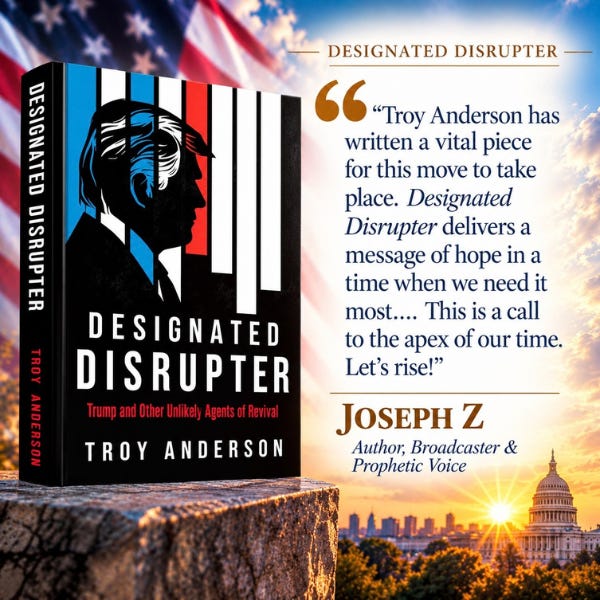
What if revival comes through the people we least expect? In Designated Disrupter: Trump and Other Unlikely Agents of Revival, Troy Anderson investigates how unexpected voices and cultural figures are influencing conversations about faith, repentance and spiritual awakening at a pivotal moment in America.
Drawing on biblical insight, investigative reporting, historical parallels and revival movements, Anderson explores what he describes as America’s “Nineveh moment”—and challenges readers to consider their own role in prayer, revival and the next Great Awakening.
Discover the unlikely agents, the signs of awakening and the call to revival.
EXPLORE DESIGNATED DISRUPTER ON AMAZON →
A Prayer for Truth, Discernment and Salvation
Heavenly Father,
In a world changing faster than many of us can comprehend, give us wisdom to recognize truth, discernment to resist deception and courage to remain faithful to You. Help us examine the events of our time carefully without fear or speculation, testing what we see and hear against Your Word.
As technology, political power and global systems continue to change, remind us that our ultimate hope is not found in governments, leaders, financial systems or human technology. Our hope is in Jesus Christ alone.
Awaken those who do not yet know You. Bring repentance, revival and spiritual awakening to our families, our nation and the nations of the world. Help Your Church remain watchful, prayerful and faithful, boldly sharing the Gospel and the hope we have in Christ.
In Jesus’ name, Amen.
Do You Know Jesus Christ?
Ultimately, understanding prophecy is not as important as knowing the One to whom Scripture points. The Bible teaches that we have all sinned and need God’s forgiveness, and that salvation is offered through Jesus Christ, who died for our sins and rose again.
If you desire to turn to Christ, you can call upon Him in sincere repentance and faith:
Lord Jesus, I know that I need You. I confess my sins and ask You to forgive me. I believe You are the Son of God, that You died for my sins and rose from the dead. I repent and turn to You. I receive You as my Lord and Savior. Make me new, fill me with Your Holy Spirit and help me follow You all the days of my life. Thank You for Your grace, Your forgiveness and the gift of eternal life. In Jesus’ name, Amen.
If you prayed sincerely, begin reading the Bible, talk with God in prayer and connect with a Bible-believing church where you can grow in your relationship with Christ.
Investigate the evidence. Examine the Scripture. Seek the truth. And above all, keep your eyes fixed on Jesus Christ.
Continue the Investigation: Trump vs. the Beast
The questions raised in this investigation go much deeper in Trump vs. the Beast: The Ten Kings Prophecy and Bible’s Revelation of Coming Final Days.
Pastor Paul Begley and Troy Anderson investigate the mysterious Ten Kings of Revelation, the rise of artificial intelligence and technocratic power, global systems of influence, national sovereignty, digital financial technologies and the biblical warnings surrounding the final days. The book asks readers to examine how rapidly changing political, economic and technological systems could intersect with ancient biblical prophecy—while confronting the larger spiritual questions behind the headlines.
Releases October 6, 2026.
Continue the investigation. Examine the evidence. Explore the prophecy.

Have a Story or Message That Belongs in a Book?
Perhaps your own research, life experience, testimony or message has led you to a story that needs to be told. Inspire Literary Group works with aspiring and established authors to transform important ideas into compelling books through ghostwriting, editing, book proposal development, publishing guidance and author support.
Whether you have a finished manuscript or simply an idea you believe could impact others, our team can help you take the next step—from concept to publication.
For a free consultation, contact six-time #1 Amazon and ECPA Bestsellers author and Inspire Literary Group Founder and President Troy Anderson at troyanderson@inspireliterary.com or call 949-887-1511.
Books Change Lives. Yours Could Be Next.
Shared