


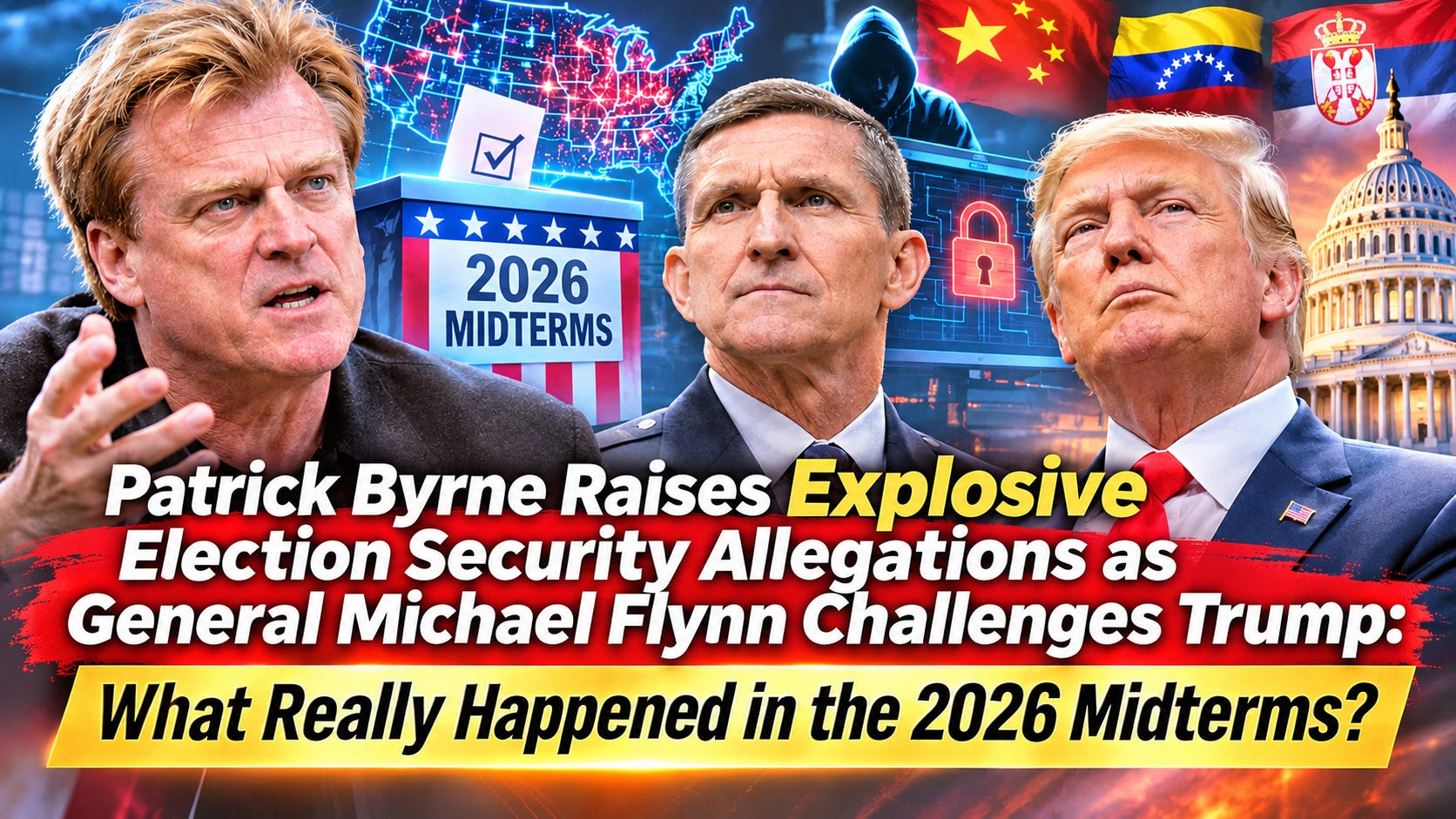
Following the Democrats’ sweeping midterm victories, former Overstock CEO Patrick Byrne raises allegations of foreign-linked vulnerabilities in America’s voting systems, while retired Lt. Gen. Michael Flynn calls on President Trump to confront leadership failures and broken promises. As questions intensify over election integrity, national security, and the future of the republic, what does the evidence actually reveal?

📖 DISCOVER TROY ANDERSON’S INSPIRING BOOK COLLECTION
Explore bestselling books investigating biblical prophecy, world events, faith, and the extraordinary stories shaping our times by seven-time #1 Amazon and ECPA Bestsellers author Troy Anderson.
Two Warnings Emerge From America’s Midterm Election Upheaval
In the aftermath of the November 3, 2026, midterm elections, two prominent figures associated with President Donald Trump’s political movement have raised sharply different questions about what went wrong and what should happen next. Their warnings arrive amid renewed debate over America’s election infrastructure, foreign cyber threats, and the political accountability of those entrusted with governing the nation.
Patrick Byrne, the former Overstock.com chief executive who became a prominent advocate of election-fraud allegations following the 2020 presidential election, has returned with new claims involving foreign influence, voting technology, and potential vulnerabilities in America’s election systems. In a recent interview on His Glory’s Take FiVe, Episode 2439, Byrne argued that the 2026 midterms resemble the controversies surrounding the 2020 election and urged Trump to authorize a rapid forensic examination of selected voting systems.
Meanwhile, retired Lt. Gen. Michael Flynn, Trump’s former national security adviser and former director of the Defense Intelligence Agency, has issued a public challenge to the president following the Republican electoral setback. In a November 4 open letter, Flynn called for an honest assessment of the party’s failures, warning that political leaders cannot overcome defeat without confronting broken promises, flawed decisions, and failures of accountability.
Support Our Mission: Help Prophecy Investigators uncover the truth, investigate biblical prophecy, and explore the forces shaping our world. Become a paid subscriber and support independent journalism rooted in truth, discernment, and faith.
Patrick Byrne’s Warning: Is America Facing Another Election Security Crisis?
During his interview with Pastor Dave on His Glory, Byrne described the 2026 election controversy as a troubling repetition of events he believes occurred six years earlier. He argued that cybersecurity concerns surrounding the 2020 presidential election were never adequately resolved and suggested that the same alleged weaknesses could have affected the November 2026 midterm election.
Byrne referenced the SolarWinds cyberespionage campaign, a major intrusion discovered in 2020 that compromised numerous government agencies and private organizations. The SolarWinds incident demonstrated how sophisticated attackers could infiltrate trusted software supply chains and gain access to sensitive computer networks. However, it did not establish that American voting machines were manipulated or that election results were changed.
Byrne went further, alleging that certain voting technologies had historical connections to Venezuela and that foreign actors, including individuals or organizations associated with China, had influenced their development or operation. He claimed that an undisclosed intermediate server could allow election data to be manipulated while bypassing conventional monitoring systems.
One of his most dramatic assertions involved an estimate that approximately 20 million votes might have been affected by manipulation. Byrne did not present independently authenticated forensic evidence establishing that figure, and no reliable public findings reviewed for this report substantiate such widespread alteration of the 2026 vote.
These allegations are serious because they concern the integrity of a foundational American institution. Nevertheless, their significance does not eliminate the need for proof. The central investigative question is whether Byrne’s technical claims can be connected to identifiable equipment, authenticated system records, and independently reproducible findings.

Discover Trump vs. the Beast
By Pastor Paul Begley and Troy Anderson | Forewords by Kevin Sorbo and Joseph Z
Could artificial intelligence, escalating geopolitical tensions, and the “Ten Kings” of the Book of Revelation be setting the stage for the rise of the Antichrist? Discover the explosive investigation, prophetic insights, and powerful message of faith, hope, and revival in Trump vs. the Beast: The Ten Kings Prophecy and the Bible’s Revelation of Coming Final Days (Humanix Books/Newsmax Media, October 6, 2026), the #1 “Best Seller” and #1 “Hot New Release” in “Prophecies” on Amazon.
The Alleged Hidden Server: What Does the Technical Evidence Show?
Among Byrne’s most consequential allegations is the existence of what he described as an intermediate server operating within election infrastructure. According to his account, election information could pass through this additional system before reaching its intended destination, potentially allowing unauthorized individuals to manipulate data without being detected by monitoring devices.
Byrne also referred to sensors, cybersecurity monitoring technology used in some government networks, suggesting that an intermediate system might evade certain forms of detection. His explanation raises questions about network architecture, access controls, and the limitations of security monitoring, but it does not establish that the alleged server exists in the systems he identified or that it was used to alter election results.
Technically, an electronic system can contain multiple servers, databases, or network connections for legitimate administrative purposes. Establishing malicious activity would require evidence showing the system’s actual configuration, unauthorized access, alterations to protected election data, and a connection between those alterations and reported vote totals.
Byrne further alleged that election systems in certain jurisdictions had been accessed remotely during earlier election cycles. He referenced purported foreign internet connections, forensic examinations, and records that he said demonstrated unauthorized activity. Those specific allegations require verification against original logs, forensic images, official incident reports, and responses from the relevant election authorities.
An important distinction concerns the type of system involved. Unauthorized access to a voter-registration database, an election-night reporting website, or an election-management network would raise different security questions, and none would automatically establish that paper ballots or certified vote totals had been altered.
For that reason, Byrne’s technical narrative should be treated as a collection of investigative leads rather than a confirmed account of how the 2026 election was conducted.
Venezuela, China, and the Allegations of Foreign Election Interference
Byrne’s interview also revived allegations involving Venezuela, China, and the origins of American voting technology. He claimed that software associated with Venezuelan election systems had influenced equipment subsequently used in the United States, while also alleging that Chinese programmers and manufacturers had played roles in the development of sensitive components.
He additionally referred to purported evidence involving foreign intelligence figures, software engineers, and communications that he said could expose an international operation targeting American elections. Among the materials he cited was a recently publicized dossier associated with election activist Joe Oltmann, which Byrne characterized as containing important evidence of foreign involvement.
A November 14 presentation attributed to Oltmann has been discussed in subsequent reporting, including allegations concerning remote access, result-import procedures, and election-system monitoring. However, the existence of a presentation or collection of documents does not independently authenticate the underlying records or establish that the alleged activities occurred.
There is also an important technical distinction between foreign manufacturing and foreign control. Computer components and software may be produced through international supply chains without establishing that a foreign government can remotely manipulate the systems in which they are installed.
In July 2026, the Center for Strategic and International Studies examined newly released intelligence documents concerning Chinese election-related activity. Its analysis acknowledged genuine vulnerabilities in electronic systems while emphasizing that the documents did not establish that votes had been changed in the 2020 election.
The broader history of foreign influence operations is well documented, but influence campaigns, cyberespionage, unauthorized access, and actual manipulation of vote totals are different activities requiring different forms of evidence.
That distinction remains essential when examining Byrne’s allegations about the 2026 midterms.
Could history, biblical prophecy, and extraordinary coincidences reveal a deeper story behind Donald Trump’s rise to power and America’s future? In The Trump Code, Troy Anderson explores remarkable historical parallels, prophetic mysteries, and the spiritual questions surrounding one of the most consequential political figures of our time. ORDER YOUR COPY TODAY
General Michael Flynn Challenges Trump: Accountability Begins With Leadership
While Byrne concentrated on alleged technological and foreign threats, Flynn delivered a different message following the Republican electoral defeat.
On November 4, Flynn published an open letter to President Trump titled A Letter to POTUS, with the subtitle The Election May Be Over, but the Fight for America’s Future Continues. Drawing upon his military background, Flynn urged the president to conduct an After Action Review, a disciplined process used to examine what happened during an operation, why it happened, and how future performance can be improved.
Flynn outlined five principles: acknowledge and take responsibility for failure, change unsuccessful approaches, identify the underlying causes of defeat, reevaluate the leadership team, and establish clear objectives for the future. His letter specifically raised questions about promises made but not fulfilled, strategic decisions, preparation, and the performance of those advising the president.
He also encouraged Trump to humble himself before God and seek wisdom through prayer, connecting his call for political accountability with a spiritual appeal for reflection and renewed leadership.
Flynn’s public comments on X were similarly pointed. In statements reported following the election, he criticized the tendency to explain political losses without confronting underlying failures and warned that voters expected more than additional promises.
The significance of Flynn’s intervention lies partly in its contrast with Byrne’s argument. Rather than claiming in his November 4 letter that voting-machine manipulation caused the Republican losses, Flynn emphasized leadership responsibility and the need to regain public trust.
His position introduces a question that cannot be resolved through cybersecurity analysis alone: Even if America’s election systems are secure, have political leaders adequately fulfilled the commitments they made to the voters who elected them?
Byrne Urges Trump to Bring Flynn Back Into National Security Leadership
One of the interview’s most noteworthy moments came when Byrne urged President Trump to consider appointing Flynn as national security adviser. Byrne praised Flynn’s military intelligence background and argued that his experience with unconventional threats could help the administration confront what Byrne describes as a form of warfare involving cyber operations, information manipulation, and foreign influence.
Byrne also revisited a December 18, 2020, Oval Office meeting involving Trump, Flynn, attorney Sidney Powell, and others. According to Byrne’s account, the participants advocated a limited investigation of voting systems following the presidential election and believed that federal technical resources could help resolve disputed allegations.
He suggested that Trump now faces a comparable decision and argued that a targeted forensic examination could be conducted without resorting to more extraordinary measures, including martial law.
However, Byrne’s description of presidential authority should not be treated as an established legal conclusion. American elections are primarily administered by state and local governments, while federal investigative authority is governed by constitutional protections, statutory limitations, judicial oversight, and rules concerning the preservation and examination of election records.
Any legitimate examination would require a lawful basis, properly authorized access, reliable forensic procedures, and safeguards against political interference.
It is also important to distinguish Byrne’s recommendation from Flynn’s own public statements. Flynn’s November 4 letter did not call for his appointment as national security adviser, nor did it endorse Byrne’s specific allegations about voting-system manipulation.
Books Change Lives. Yours Could Be Next.

Have a story worth telling? Inspire Literary Group, founded by seven-time #1 bestselling author Troy Anderson, offers professional ghostwriting, editorial development, and publishing guidance to help transform your vision into a powerful book that inspires lives and leaves a lasting legacy.
Ready to tell your story? Schedule a complimentary book, film, or television project consultation. Email: troyanderson@inspireliterary.com Phone: 949-887-1511
What Federal Cybersecurity Officials Have Actually Confirmed
The debate over election security extends beyond the claims raised in Byrne’s interview. On October 16, 2026, the Federal Bureau of Investigation and the Cybersecurity and Infrastructure Security Agency issued a public warning concerning cyber threats directed at election officials, candidates, and political organizations.
The agencies identified phishing, deceptive text messages, attempts to steal login credentials, and other methods that malicious actors could use to compromise sensitive information or disrupt election-related operations. These warnings demonstrated that cybersecurity threats facing American elections are genuine and require sustained attention.
Separately, researchers have identified vulnerabilities in certain voting technologies under specific conditions, including weaknesses involving software configurations, physical access, and system administration. Such findings underscore the importance of security testing, access controls, software updates, transparent audits, and independent verification of election results.
Nevertheless, the discovery of a vulnerability does not establish that an attacker exploited it during an actual election. Nor does an attack against a campaign, election office, or public-facing website necessarily demonstrate that ballots were altered.
Paper records and post-election audits provide important independent checks on electronic tabulation. When allegations involve changed vote totals, investigators must compare the relevant electronic records with preserved ballots, documented custody procedures, and official canvassing or audit results.
As of this report, the evidence reviewed does not independently substantiate Byrne’s allegations of coordinated foreign manipulation affecting the 2026 midterm vote totals.
That conclusion does not mean election-security questions should be ignored. It means that credible investigations must follow verifiable evidence rather than assume their conclusions in advance.
The Larger Question: Who Is Responsible for Protecting America’s Republic?
Throughout my career as an investigative journalist and author, I have examined the intersection of geopolitical upheaval, technological transformation, national security, and biblical prophecy. In books including The Trump Code, The Babylon Code, coauthored with Paul McGuire, and Revelation 911 and Trump vs. the Beast, both coauthored with Pastor Paul Begley, I have explored the forces shaping modern institutions and the spiritual questions confronting believers in an increasingly interconnected world.
The current controversy over election security raises legitimate concerns about the concentration of technological power, the resilience of essential institutions, and the responsibility of public officials to maintain public confidence. Yet it also demonstrates how easily unverified allegations can become intertwined with political frustration, particularly when election results disappoint large segments of the population.
Scripture repeatedly warns against deception, corruption, and the abuse of authority, but it also teaches the importance of careful judgment. Proverbs 18:17 reminds us that the first account of a dispute may appear persuasive until another person comes forward to examine it.
That biblical principle applies directly to the claims now circulating about the 2026 midterms. Christians should neither dismiss credible evidence of wrongdoing nor repeat allegations as established facts without examining their foundations.
The Book of Revelation warns of future systems of political, spiritual, and economic coercion, particularly in Revelation 13. However, Scripture does not identify contemporary American voting machines or establish that a particular election dispute fulfills those prophecies.
Our responsibility is to remain watchful, prayerful, and discerning while seeking the truth wherever it leads.

THE BABYLON CODE: Solving the Bible’s Greatest End Times Mystery
In this bestselling investigation, Paul McGuire and Troy Anderson explore the mysteries of ancient Babylon, the rise of global power structures, and the prophetic warnings of Scripture. Discover how biblical prophecy offers insight into today’s changing world—and why spiritual discernment matters more than ever.
What Happens Next? The Questions That Demand Answers
Several important questions remain unresolved. Will Byrne and other election-security advocates release independently verifiable technical records supporting their allegations? Will the purported Oltmann dossier withstand scrutiny by qualified forensic specialists? Will election administrators and voting-system vendors respond to the specific claims involving servers, unauthorized access, and foreign software connections?
Equally important, will President Trump respond to Flynn’s call for a serious assessment of Republican leadership, policy decisions, and unfulfilled promises?
These are different questions, but both involve the public’s confidence in the institutions entrusted with governing the nation.
The evidence currently available supports a clear distinction: Byrne has advanced allegations concerning possible election manipulation, while Flynn has publicly called for political accountability. Neither development, on its own, establishes that the 2026 midterm results were fraudulently altered.
For Americans concerned about the future of their republic, the guiding principle should remain straightforward. Investigate credible allegations, preserve relevant evidence, demand transparency from public officials, and allow conclusions to follow independently verifiable facts.
For believers, there is also a deeper responsibility. We must pray for those in authority, pursue justice without abandoning truth, and remember that our ultimate hope rests not in political institutions but in Jesus Christ.
Discover I’ve Been to Heaven

I’ve Been to Heaven | A Remarkable Journey of Faith, Heaven, and Eternal Hope
What happens when our earthly journey comes to an end? In I’ve Been to Heaven, Steve Boyls and Kathy Boyls, MD, and bestselling author Troy Anderson explore an extraordinary personal account of heaven, faith, and the hope of eternal life. As Dickens’s A Tale of Two Cities reminds us of the power of sacrifice and redemption, this inspiring book invites readers to reflect on the promises of Jesus Christ and the hope that reaches beyond the grave.
A Prayer for Truth, Justice, and America’s Future
Heavenly Father, we come before You at a time of uncertainty and division in our nation, asking You to bring truth into the light, expose genuine wrongdoing wherever it exists, and give wisdom, integrity, and courage to those entrusted with public responsibility.
Lord, protect America from deception, corruption, foreign threats, and the misuse of power. Guide our leaders to act with humility, uphold justice, and honor the responsibilities of their offices. Help the American people distinguish truth from speculation, pursue understanding rather than division, and place their confidence in Your righteousness.
Above all, turn our hearts toward You. Remind us that our security is ultimately found not in governments, political parties, or earthly systems, but in Your eternal promises.
In Jesus’ mighty name, Amen.
An Invitation to Know Jesus Christ
Amid political uncertainty and the challenges facing our world, the greatest decision any of us can make is to place our faith in Jesus Christ. Romans 10:9 teaches that those who confess Jesus as Lord and believe that God raised Him from the dead will be saved.
If you have never surrendered your life to Christ, you can turn to Him today. Ask Him to forgive your sins, renew your heart, and guide your life. His grace is available to everyone who sincerely calls upon Him, and His promise of eternal life offers a hope that no political crisis can take away.
Our ultimate hope is not found in the outcome of an election, but in the eternal kingdom of God.
Discover the Prophecies Behind Today’s Global Upheaval
As America faces political uncertainty and renewed questions about election integrity, explore Troy Anderson’s investigative books, including The Trump Code, The Babylon Code (coauthored with Paul McGuire), I’ve Been to Heaven, Revelation 911, and Trump vs. the Beast (both coauthored with Pastor Paul Begley).
These books examine the intersection of biblical prophecy, political upheaval, global power, emerging technologies, and spiritual deception while encouraging believers to remain watchful, discerning, and grounded in Scripture.
DISCOVER TROY ANDERSON’S INSPIRING BOOK COLLECTION
Watch the Interview and Read General Flynn’s Statements
1. Patrick Byrne’s Full Interview — His Glory, Take FiVe, Episode 2439
Patrick Byrne EXPOSES Election Concerns & Enemy Within
WATCH THE FULL INTERVIEW ON YOUTUBE
2. General Michael Flynn’s Open Letter to President Trump — November 4, 202
A Letter to POTUS: The Election May Be Over, but the Fight for America’s Future Continues
READ GENERAL FLYNN’S ORIGINAL LETTER
3. General Michael Flynn’s Original X Post — November 4, 2026
Read Flynn’s public message to President Trump, outlining five recommendations for confronting the Republican election defeat, reassessing leadership, and restoring accountability. READ GENERAL FLYNN’S ORIGINAL X POST
Editorial note: This investigation distinguishes allegations made by Patrick Byrne from independently documented election-security findings and Michael Flynn’s published statements. The evidence reviewed does not establish that foreign actors manipulated the 2026 midterm vote totals. Claims involving undisclosed servers, unauthorized foreign access, and large-scale vote manipulation require further independent verification.