

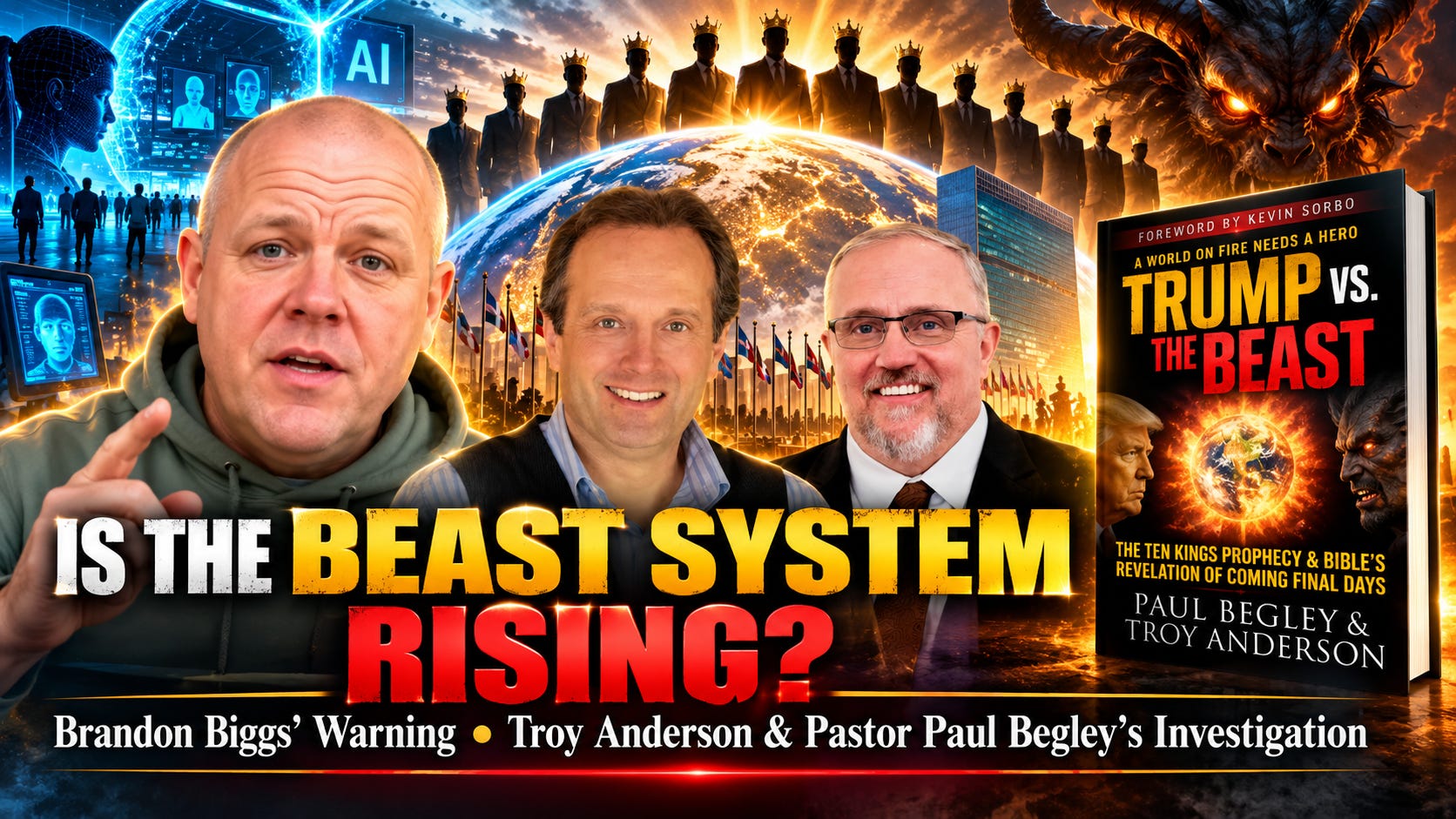
Days after Jim Bakker’s death and the release of our new book, Pastor Paul Begley and I examined a reported prophetic warning that raises profound questions about the Antichrist, the biblical restrainer and the future of global power.

🎉📖Discover Troy Anderson’s Inspiring Book Collection🎉📖
Prophecy Investigators is a reader-supported publication. If you enjoy our articles and videos, please consider becoming a paid subscriber. You will receive access to read in-depth articles, watch exclusive interviews, and partner in our mission to spread the Good News of Jesus Christ.
As an investigative journalist who has spent much of my career exploring the intersection of biblical prophecy, geopolitics, and the extraordinary events shaping our world, I’ve learned that some of the most important stories begin with a question that refuses to go away. Sometimes the question emerges from an ancient manuscript. Sometimes it arises from a conversation with a pastor, a scientist or a government official. And sometimes, as happened this week, it comes from a remarkable convergence of events that brings years of research into sharper focus.
On October 6, 2026, my friend and coauthor, Pastor Paul Begley, and I released Trump vs. the Beast: The Ten Kings Prophecy and the Bible’s Revelation of Coming Final Days (Humanix Books/Newsmax Media, October 6, 2026), a book examining one of the Bible’s most mysterious prophetic scenarios: the emergence of a powerful coalition of rulers, the rise of the Antichrist and a future system in which political authority, spiritual allegiance and economic participation become profoundly interconnected.
Just one day earlier, on October 5, Christian television broadcaster Jim Bakker died at age 86. His passing attracted renewed attention after prophetic commentator Brandon Biggs described a telephone conversation he said he had with Pastor Begley in July, nearly three months before Bakker’s death. According to Biggs, he had warned Begley that Bakker was going to “go home,” along with sharing other impressions concerning a possible devastating pandemic starting in Russia and the emergence of the biblical beast system.
Then, on October 8, Pastor Begley invited me onto his broadcast to discuss Biggs’ account, Bakker’s death and the larger prophetic questions surrounding these developments. The timing was striking, particularly because the subjects Biggs was discussing—the mysterious restrainer, the Antichrist, the consolidation of global power and the possibility of a future system of economic control—were closely related to the questions Pastor Begley and I had been investigating long before the book reached readers.
But it was one particular statement from Biggs that caught my attention. During his recent broadcast, he declared that “the beast system will no longer be held back,” adding that “the restraining force is being lifted.”
Those words immediately brought to mind the apostle Paul’s mysterious teaching in 2 Thessalonians 2, where he describes a force holding back the revelation of the man of lawlessness until an appointed time. Christians have debated the identity of this restrainer for nearly two thousand years, with interpretations ranging from the Holy Spirit working through the church to lawful government, angelic authority and God’s sovereign control over history.
As I considered Biggs’ warning alongside the research behind Trump vs. the Beast, the #1 “Hot New Release” in “Prophecies” on Amazon, I found myself returning to a question that reaches far beyond the death of one prominent Christian broadcaster: Could the modern world’s rapidly evolving systems of political, technological and economic power eventually provide the infrastructure for the kind of authority described in Daniel and Revelation?
I am not suggesting that Biggs’ predictions have been conclusively verified, that the biblical restrainer has been removed or that the Antichrist has already emerged. But I do believe the underlying questions deserve serious investigation, especially as artificial intelligence, digital financial networks, biometric identification and increasingly sophisticated surveillance technologies transform the relationship between individuals and powerful institutions.
What makes this moment worth examining is not simply the timing of a book release or a reported prophetic warning. It is the possibility that technologies once confined to science fiction are changing the practical limits of political and economic control—and that ancient biblical passages may offer a meaningful framework for considering the spiritual implications of those changes.
That is the mystery I want to explore.
The Warning Pastor Begley Received Months Before Jim Bakker’s Death
During our October 8 discussion, Pastor Begley and I examined an account that has attracted considerable interest among Christians who follow contemporary prophetic voices. According to Brandon Biggs, he contacted Begley in July 2026 because he believed God had revealed several events that would unfold in the months ahead, and he wanted someone outside his immediate ministry circle to document the warnings before they occurred.
One of those warnings concerned Jim Bakker, the influential and controversial television evangelist whose career stretched across more than five decades. Biggs recalled telling Begley, “Jim Baker is going to go home,” using a familiar Christian expression referring to death. Biggs said he asked Begley to write down the statement, but the pastor reportedly responded, “I’ll do better. I’ll record it.” Biggs also recounted that Begley placed the call on speakerphone so his wife could hear their conversation.
Bakker’s death on October 5 made that reported exchange particularly noteworthy. Alongside his former wife, Tammy Faye, Bakker had helped establish the PTL ministry as a major force in American Christian broadcasting before his career collapsed amid scandal and a federal conviction. After serving time in prison, he returned to television and eventually became known for his emphasis on biblical prophecy, national emergencies and preparations for future crises. His life was marked by considerable influence, controversy and a continuing public interest in the last days. Pastor Begley and I have gone on The Jim Bakker Show on many occasions over the years.
According to Biggs and Begley’s descriptions, the July conversation also involved warnings about a possible disease outbreak and the emergence of a system of extraordinary political, economic and spiritual control associated with the biblical Antichrist.
In subsequent remarks, Biggs described prophetic impressions involving laboratory activity, biological manipulation and a potential public-health emergency that he believes could accelerate the movement away from physical currency toward more comprehensive digital financial systems. Those allegations remain unverified, and I have not seen independently established evidence demonstrating that such an outbreak is being deliberately engineered or that a coordinated plan exists to use a future health emergency to impose a global system of economic control.
Biggs has also acknowledged that his interpretation of prophetic timing may be mistaken. Discussing an earlier expectation involving 2027, he conceded, “It looks like I missed the timing of the year.”
Nevertheless, Biggs’ larger warning raises a question that has fascinated Christians for centuries. What if the forces described in biblical prophecy are not simply associated with the sudden appearance of a future world ruler, but also involve the gradual development of political, economic and technological systems capable of supporting his authority?
That possibility is one of the central questions Pastor Begley and I explore in Trump vs. the Beast.
Is AI Building the Infrastructure of the Beast?
Could artificial intelligence, digital currencies, biometric identification and expanding surveillance technologies help create the foundations of the system described in Revelation 13?
In Trump vs. the Beast: The Ten Kings Prophecy and the Bible’s Revelation of Coming Final Days, Pastor Paul Begley and I investigate the intersection of ancient biblical prophecy, emerging technologies and the extraordinary transformation of global power.
The technology is advancing. The prophetic questions are growing. Explore the investigation.
Get Your Copy of Trump vs. the Beast on Amazon →
The Mystery of the Restrainer: What Is Holding Back the Antichrist?
When Brandon Biggs declared that the restraining force is being lifted, he was invoking one of the most debated passages in the New Testament. In 2 Thessalonians 2, the apostle Paul addresses believers who were troubled by claims concerning the day of the Lord. He warns them about deception, describes a coming rebellion and introduces a mysterious figure known as the man of lawlessness, whom many evangelical interpreters associate with the future Antichrist.
Paul explains that the mystery of lawlessness was already at work in his own time, yet something—or someone—was preventing its fullest manifestation. The man of lawlessness would be revealed only after the restraining influence was removed, and even then, his emergence would occur according to an appointed time. Paul does not identify the restrainer explicitly in the surviving letter, apparently because the Thessalonian Christians had already received additional instruction on the subject.
Among contemporary evangelical prophecy teachers, one influential interpretation identifies the restrainer with the Holy Spirit working through the church. Within certain futurist understandings of biblical prophecy, the removal of this restraining ministry is associated with the rapture, when believers are gathered to Christ before a period of extraordinary tribulation. Biggs has identified the restrainer with the church, making his warning especially significant within that theological framework.
Other Christians understand the passage differently. Some early interpreters associated the restrainer with the Roman Empire or lawful governmental authority, while others have suggested an angelic being such as Michael, or God’s sovereign control over the timing of future events. These interpretations reflect substantial differences in how Christians understand the relationship between spiritual authority, political order, the church and the return of Jesus Christ.
The distinction matters because saying that the restrainer is being lifted can mean different things depending on the interpretation. Is Biggs suggesting that the rapture is approaching? Does he believe the church’s spiritual influence is weakening? Or is he describing a period in which God permits a greater manifestation of lawlessness while the church remains present on earth?
Scripture does not provide a basis for treating Bakker’s death, the release of a contemporary book or a particular prophetic declaration as proof that the restrainer has been removed. Yet Paul’s teaching presents a profound theological question: If the forces of lawlessness are already active in history, what limits their power, and what might happen when those limits are withdrawn?
For me, that question becomes especially intriguing when considered alongside the political and technological transformations of the modern world. The Bible does not tell us that artificial intelligence, digital currencies or surveillance networks constitute the restrainer or the Antichrist. But it does invite serious reflection on the nature of power, deception and the dangers of placing ultimate allegiance in earthly authorities.
The apostle Paul’s account also contains an essential reminder that can easily be lost amid dramatic end-times predictions. The man of lawlessness does not prevail indefinitely. In 2 Thessalonians 2:8, Paul describes his ultimate destruction through the appearing of Jesus Christ. The passage is therefore not simply a warning about the rise of evil, but a declaration that evil remains subject to God’s authority and will ultimately be defeated.
Past. Present. Future. Could History Hold the Key to America’s Destiny?
What if forgotten books, Nikola Tesla’s extraordinary inventions and mysterious connections across time offered unexpected clues about America’s future?
In The Trump Code, bestselling author and investigative journalist Troy Anderson explores the fascinating intersections of history, biblical prophecy, time travel theories and the extraordinary mysteries surrounding Donald Trump and America’s destiny.
From the late 1800s Baron Trump novels of Ingersoll Lockwood to the technological revolution of today, discover an investigative journey that challenges readers to reconsider the connections between the past, present and future.
Some mysteries are too extraordinary to ignore. Follow the clues. Discover The Trump Code.
Get Your Copy of The Trump Code on Amazon →
The Ten Kings: An Ancient Prophecy About the Concentration of Power
One of the reasons Pastor Begley and I wrote Trump vs. the Beast was to investigate the mysterious Ten Kings prophecy described in Daniel 7 and Revelation 17. These passages portray an extraordinary concentration of political authority involving multiple rulers and a dominant figure associated, within many futurist interpretations, with the Antichrist.
In Daniel 7, the prophet describes four beasts representing kingdoms, culminating in a terrifying fourth beast possessing ten horns. From among those horns emerges another ruler characterized by arrogance, opposition to God and persecution of the saints. Daniel 7:24 identifies the ten horns as ten kings arising from a kingdom, introducing imagery that has challenged biblical interpreters for centuries.
The apostle John presents a striking parallel in Revelation 17, where ten kings receive authority alongside the beast for a limited period and ultimately surrender their power to him. Within a futurist understanding of biblical prophecy, these passages suggest that the emergence of the Antichrist may involve more than the rise of one ambitious ruler. It could also involve a coalition of authorities whose power becomes concentrated under a dominant political and spiritual figure.
Christian traditions differ in their interpretations of these visions. Some associate them primarily with ancient empires and Roman imperial power, while others understand them as recurring patterns of oppression or as descriptions of a future political order. Neither Daniel nor Revelation identifies ten contemporary nations, corporations or international institutions as the fulfillment of the prophecy.
Yet the underlying image is extraordinary: multiple centers of authority becoming aligned around a common purpose, ultimately transferring their power to one dominant figure.
As I examine today’s geopolitical landscape, I am struck by how different the mechanisms of power have become from those available to ancient empires. Modern governments exercise authority not only through armies, laws and territorial boundaries, but also through financial institutions, communications networks, digital infrastructure, international agreements and technologies capable of influencing enormous populations.
A financial crisis in one country can quickly affect markets around the world. Decisions involving monetary policy, international security or critical technological infrastructure can produce consequences far beyond the borders of the nations or institutions making them. Artificial intelligence adds another dimension by enabling the collection, analysis and coordination of vast amounts of information at speeds that earlier generations could scarcely have imagined.
None of this establishes that the Ten Kings have appeared. International cooperation is not inherently equivalent to the biblical beast system, and the existence of powerful institutions does not prove that they are secretly preparing to surrender their authority to the Antichrist.
But the prophecy raises an important question about the future: Could an extraordinary crisis eventually encourage governments and influential institutions to consolidate authority in ways that fundamentally change the relationship between nations, individuals and the centers of power governing their lives?
In Trump vs. the Beast, Pastor Begley and I examine that possibility through the lens of Scripture, history, geopolitics and emerging technologies. We do not have a verified list of ten modern rulers who fulfill Revelation 17, and I believe readers should be cautious about claims that confidently identify them. What interests me is the broader pattern described in the biblical text: a concentration of authority that ultimately becomes inseparable from spiritual allegiance and opposition to God.
That leads to an even more unsettling passage—one in which the exercise of power extends directly into everyday economic life.
Prophecy Meets Today’s Headlines
What can the ancient visions of Revelation tell us about the extraordinary events unfolding across our world?
In Revelation 911: How the Book of Revelation Intersects with Today’s Headlines, Pastor Paul Begley and Troy Anderson explore biblical prophecy, global upheaval and the spiritual questions facing our generation—offering readers a compelling invitation to examine the signs of the times through Scripture.
Discover the prophecy. Explore the headlines. Find hope in God’s promises.
Get Your Copy of Revelation 911 on Amazon →
Revelation 13: Could the Infrastructure of a Beast System Already Be Developing?
For centuries, Christians have studied the disturbing vision in Revelation 13 describing a beast that exercises extraordinary authority and a second beast that compels allegiance to the first. Among the chapter’s most consequential details is the description of a mark associated with the right hand or forehead, without which people cannot buy or sell.
The passage has generated extensive debate. Some Christians understand the mark as a literal future mechanism of identification and economic control. Others interpret it symbolically, emphasizing loyalty to powers opposed to God, or connect the imagery to the pressures experienced by early Christians living under Roman imperial authority.
Whatever interpretation one adopts, Revelation 13 raises a question that has become increasingly relevant in the modern world: What happens when participation in ordinary economic life becomes conditional upon submission to a powerful authority?
For most of human history, enforcing such a restriction across vast populations would have been extraordinarily difficult. Commerce depended heavily on physical currency, local relationships and transactions that could occur without immediate approval from a centralized network. Modern technological systems are transforming those conditions.
Artificial intelligence can analyze enormous quantities of information and support automated decisions affecting individuals and institutions. Biometric identification can authenticate identity through facial recognition, fingerprints and other physical characteristics. Digital payment networks allow transactions to move across national boundaries almost instantaneously, while sophisticated surveillance technologies can collect and connect information about human activity on an unprecedented scale.
These innovations offer substantial benefits. Artificial intelligence is advancing scientific research, assisting medical professionals and improving the efficiency of complex systems. Digital payments provide convenience and can expand access to financial services. Biometric authentication can reduce certain forms of fraud, while modern data analysis helps institutions address legitimate security challenges.
But technological capabilities that provide extraordinary benefits can also create extraordinary risks when concentrated in the hands of authorities operating without sufficient transparency, accountability or protection for individual rights.
Consider a hypothetical system in which digital identification, financial accounts, personal information and automated enforcement mechanisms become closely interconnected. A person’s identity could be verified through biometric credentials, transactions could be approved or rejected through a digital network, and automated systems could evaluate information to determine whether access to particular services should be restricted.
Under accountable institutions, such capabilities might improve security and efficiency. Under authoritarian control, however, similar infrastructure could potentially be used to monitor dissent, penalize religious or political expression, restrict transactions or exclude individuals from essential economic services.
The crucial issue is not whether technology itself is inherently evil. It is who controls the technology, what rules govern its use and whether individuals possess meaningful protections against abuse.
This is where I believe the discussion surrounding Revelation 13 becomes particularly significant. The biblical passage does not identify artificial intelligence, smartphones, central bank digital currencies, biometric identification or implanted payment devices as the mark of the beast. More importantly, the mark is connected to the beast’s identity and a broader system of worship and allegiance, not simply to a method of conducting financial transactions.
Nevertheless, the growing ability of powerful institutions to authenticate identities, monitor activity and regulate access to financial systems raises legitimate concerns about how technological infrastructure might be used in the future.
A society does not need to fulfill biblical prophecy for these questions to matter. Financial privacy, freedom of conscience, due process and protection against arbitrary exclusion are important in their own right. But for Christians who understand Revelation 13 as describing a future system of coercive political and spiritual authority, the development of such technologies adds another dimension to the investigation.
Could a future beast system emerge not through one dramatic technological invention, but through the gradual integration of systems that already exist?
That is a possibility worth examining carefully, without confusing what technology might enable with evidence that a particular prophecy has already been fulfilled.
Is Heaven Real? Discover an Extraordinary Story of Faith and Hope
What happens when a near-death experience offers a remarkable glimpse of heaven?
In I’ve Been to Heaven, Steve and Kathy Boyls, MD, and Troy Anderson share a deeply moving account of a husband’s extraordinary near-death experience, his wife’s prayers and a powerful message of faith, hope and God’s love.
Discover an inspiring true story that reminds us heaven is a promise worth exploring and hope is never lost.
Get Your Copy of I’ve Been to Heaven on Amazon →
Brandon Biggs’ Warning About a Cashless Future
One of the more disturbing aspects of Brandon Biggs’ recent remarks was his suggestion that a major public-health emergency could accelerate the movement away from physical currency and toward increasingly comprehensive electronic financial systems.
In his broadcast, Biggs described prophetic impressions involving laboratory activity, biological manipulation and a possible disease outbreak. He suggested that the resulting public concern could encourage people to avoid handling physical money and rely more heavily on digital payments, potentially setting the stage for future identification and transaction technologies.
His interpretation connects this scenario to the mark of the beast described in Revelation 13. It reflects a concern shared by some contemporary prophecy commentators that the infrastructure for a future system of economic control could develop long before the ultimate purpose of such a system becomes apparent.
These claims require important qualifications. Biggs’ descriptions of a deliberately engineered outbreak have not been independently established, and there is no evidence in the material examined that a coordinated effort is underway to manufacture a public-health emergency for the purpose of imposing a global financial-control system.
Nor should different forms of digital money be treated as interchangeable. Cryptocurrencies, commercial bank deposits, private electronic payment platforms and central bank digital currencies operate through different technological and institutional arrangements. The expansion of digital payments does not necessarily require the elimination of physical currency, universal surveillance or implanted identification devices.
Yet I believe the underlying questions about financial freedom deserve attention. As more transactions depend on digital networks, what safeguards will protect individuals from arbitrary restrictions? Who should determine whether someone may participate in essential economic activity? Can people challenge decisions made by automated systems? And what happens when the institutions controlling identification, payments and personal information become increasingly interconnected?
These questions are particularly important because financial exclusion can have profound consequences. Access to money affects a person’s ability to obtain food, housing, transportation, medical care and other necessities. Systems that can restrict such access therefore carry responsibilities that extend far beyond ordinary questions of technological convenience.
In Trump vs. the Beast, Pastor Begley and I explore how digital financial infrastructure, artificial intelligence and emerging identification technologies might influence the future distribution of power. We also examine the prophetic warnings of Daniel and Revelation concerning authority that ultimately demands allegiance beyond what belongs to any earthly institution.
The connection between those subjects does not establish that Biggs’ predictions will occur. But it helps explain why his remarks have resonated with readers and viewers already concerned about the intersection of technology, economic control and biblical prophecy.
Designated Disrupter: Trump and Other Unlikely Agents of Revival
Powerful forces. Hidden agents. A nation in transition.
Bestselling author and investigative journalist Troy Anderson explores the intersection of faith, politics and biblical prophecy—and how unlikely leaders and extraordinary events could help shape America’s spiritual future.
The Antichrist: A Future Ruler or a System Already Taking Shape?
When Christians discuss the Antichrist, attention often turns immediately to the identity of a particular individual. Throughout history, religious commentators have attempted to associate the figure with emperors, kings, political leaders and other influential personalities, frequently interpreting contemporary crises as evidence that the final confrontation described in Scripture was imminent.
Yet the biblical portrait is more complex than any single modern identification.
The term Antichrist appears in the letters of John, where it describes opposition to Jesus Christ and teachings that deny fundamental truths about His identity. In 1 John 2:18, the apostle refers both to the expectation that Antichrist is coming and to the presence of many antichrists already active in the world.
Other passages introduce figures whose characteristics have led many evangelical interpreters to connect them with a future Antichrist. Paul describes the man of lawlessness in 2 Thessalonians 2, Daniel portrays a ruler who opposes God and persecutes the saints, and Revelation depicts a beast exercising extraordinary authority and receiving worship.
Within many futurist interpretations, these passages are understood as complementary descriptions of a coming world ruler and the political, economic and religious system through which he exercises power. Other Christian traditions understand significant portions of the imagery in relation to ancient empires, the Roman world or recurring patterns of oppression throughout history.
What interests me about the futurist interpretation is the possibility that the emergence of a dominant ruler could be preceded by the development of institutions, technologies and relationships that eventually enable extraordinary concentrations of authority.
History offers many examples of political systems developing over time before a particular leader rises to prominence within them. Economic crises, social upheaval, military conflict and public fear have repeatedly created opportunities for governments to expand emergency powers or for societies to accept restrictions they might otherwise have resisted.
That does not mean every emergency measure is illegitimate or that international cooperation is inherently sinister. Governments have genuine responsibilities to protect public safety, preserve economic stability and respond to crises. The challenge is ensuring that extraordinary powers remain subject to law, public accountability and meaningful protections for individual freedom.
But the possibility that political authority could become intertwined with spiritual allegiance is precisely what makes the biblical warnings so consequential. Revelation 13 is not merely concerned with a powerful ruler who governs nations. It describes a system in which worship, identity and economic participation become connected to submission to the beast.
For that reason, I believe the more important question is not simply who the Antichrist might be. It is what kind of world could allow such a figure—or such a system—to exercise the extraordinary authority described in Scripture.
And that brings us back to Brandon Biggs’ warning about the restrainer.
If the apostle Paul’s teaching describes a future moment when lawlessness is permitted to manifest more fully, and if that development is connected to the beast of Revelation, then the political and technological conditions surrounding the emergence of such authority become an important subject of investigation.
We cannot know from Biggs’ declaration that this moment has arrived. But we can examine the structures of power developing around us, consider their implications for human freedom and evaluate them in light of the biblical principles that have guided Christians for centuries.
Why the Timing of Trump vs. the Beast Matters to Me
When Pastor Begley and I began working on Trump vs. the Beast, we were motivated by questions that had emerged through years of studying biblical prophecy and following developments in geopolitics, technology and global finance.
Pastor Begley brings decades of experience as a Christian pastor, broadcaster and commentator on biblical prophecy. My own perspective has been shaped by investigative journalism and a series of nonfiction books examining the intersection of Scripture, history, political power and contemporary events. Together, we wanted to explore what the ancient prophetic texts might reveal about the extraordinary transformation of modern civilization.
Our book examines the mysterious Ten Kings, the Antichrist, artificial intelligence, transhumanism, digital financial systems and the future of America. Featuring forewords by actor and filmmaker Kevin Sorbo and prophetic commentator Joseph Z, it invites readers to consider the biblical passages alongside the technological and geopolitical developments that are changing the world.
The October 6 release was the culmination of that work. We did not write the book in response to Brandon Biggs’ recent broadcast or Jim Bakker’s death. The research, writing and publication process preceded those events.
That is what made the timing especially striking to me. Just as the book was reaching readers, Biggs was discussing the restrainer, the emergence of the beast system and the possibility that future crises could accelerate the development of technologies associated with economic control. Those subjects closely paralleled questions Pastor Begley and I had spent considerable time investigating.
I do not believe that the timing alone establishes a supernatural explanation. A coincidence can be remarkable without constituting proof of prophetic fulfillment, and an author’s enthusiasm for a newly released book should never substitute for careful examination of the evidence.
But the convergence did provide an unexpected opportunity to revisit the book’s central questions in light of a widely discussed contemporary prophetic claim.
During our October 8 conversation, Pastor Begley and I explored the reported July warning, Bakker’s passing and the larger biblical questions concerning the restrainer and the Antichrist. For me, the discussion reinforced why I believe Christians need to approach these subjects with both spiritual seriousness and investigative discipline.
We should not dismiss every prophetic warning simply because its implications are extraordinary. Neither should we accept every dramatic prediction without examining its sources, specificity and consistency with Scripture.
The apostle Paul’s instruction in 1 Thessalonians 5:20–21 offers a foundation for that balance: believers are called not to despise prophecies, but to test everything and hold fast to what is good.
That principle has become increasingly important in an age when dramatic claims can reach millions of people within minutes, often stripped of the context needed to evaluate them responsibly.

Books Change Lives. Let Us Help You Tell Your Story.
Have a powerful story, inspiring testimony or message that deserves to be shared?
At Inspire Literary Group, bestselling author and investigative journalist Troy Anderson and his team help aspiring and established authors bring their visions to life through professional ghostwriting, editing, publishing guidance and author support.
Your story matters. Your message can change lives.
Explore Inspire Literary Group →
Beyond the Warnings: Billy Graham, Nineveh and America’s Spiritual Future
There is another dimension to these developments that I believe deserves attention, one that extends beyond the identity of the Antichrist or the technological foundations of a possible future beast system.
In 2013, I had the opportunity to interview legendary evangelist Billy Graham about America’s spiritual condition and the biblical account of Nineveh. That conversation helped shape my continuing interest in the relationship between prophetic warning, national repentance and the possibility of spiritual awakening.
The story of Nineveh, recorded in Jonah 3, has remained especially meaningful to me because it reveals a dimension of biblical prophecy that can easily be overlooked when discussions become dominated by predictions of catastrophe.
According to Scripture, God sent Jonah to warn the ancient Assyrian city that judgment was approaching. The message was severe, but the people’s response was extraordinary. They believed God, proclaimed a fast and turned toward repentance. Even the king humbled himself and called upon the population to abandon evil and violence.
The biblical account concludes with God seeing their response and withholding the announced destruction.
For me, Nineveh is a reminder that a prophetic warning does not necessarily mean hope has ended. It can also become an invitation to examine how we are living, reconsider our priorities and seek God with renewed humility.
That conviction contributed to my involvement in The Return, the national gathering for prayer and repentance held on the National Mall in Washington, D.C., in September 2020. During a period marked by the COVID-19 pandemic, political division and widespread uncertainty, Christian leaders and participants gathered to seek spiritual renewal and call the nation toward repentance.
Six years later, Pastor Begley and I are returning to similar themes through our announced “Trump vs. the Beast Save America Rescue Operation — 40 Days of Prayer, Fasting and Repentance.” The initiative reflects our belief that Christians should respond to extraordinary events not merely by analyzing headlines or attempting to identify prophetic fulfillment, but through prayer, humility, repentance, service and a renewed commitment to biblical faith.
Even Biggs’ recent broadcast, despite its dramatic predictions, included an appeal for spiritual renewal. He spoke about the possibility that difficult circumstances could encourage people to return to church, take their faith more seriously and seek a deeper relationship with God.
Whether his specific predictions unfold remains unknown. But the spiritual questions raised by our times do not depend on the accuracy of any individual prophetic claim. They concern how believers respond to fear, uncertainty, political division and the profound changes occurring across our world.
The story of Nineveh reminds me that the purpose of a warning is not simply to create anxiety about tomorrow. It can also challenge us to consider whether our lives today reflect the faith we profess.
The Final Question: Are We Watching the Rise of a Beast System?
As I reflect on Brandon Biggs’ warning, Jim Bakker’s death, my October 8 conversation with Pastor Begley and the extraordinary timing of our book’s release, I keep returning to the larger question that inspired much of our investigation.
Could the world be developing the political, technological and economic infrastructure that might one day support a system resembling the beast described in biblical prophecy?
The question cannot be answered simply by pointing to artificial intelligence, digital currencies, international institutions or the predictions of contemporary prophetic voices. None of those developments, individually or collectively, proves that the Antichrist has emerged or that the restrainer described in 2 Thessalonians 2 has been removed.
Yet the underlying changes are significant. Artificial intelligence is transforming the ability of institutions to analyze information and make decisions. Digital financial systems are reshaping the movement of money. Biometric identification and surveillance technologies are expanding the capacity to authenticate, monitor and regulate human activity. And the growing interdependence of political and economic institutions is raising difficult questions about sovereignty, accountability and the preservation of individual freedom.
These are developments that deserve investigation regardless of one’s interpretation of biblical prophecy.
For Christians, however, Daniel and Revelation add a spiritual dimension to those questions. They warn about the dangers of earthly power becoming an object of ultimate allegiance, portray systems that oppose God and persecute His people, and remind believers that even the most formidable human authorities remain subject to divine judgment.
I believe we should study those passages seriously without claiming more certainty than Scripture provides. We should examine contemporary prophetic statements without confusing conviction with verification, and we should consider the possibilities created by emerging technologies without assuming that every innovation is inherently part of an end-times conspiracy.
Above all, we should remember that the Bible’s prophetic narrative does not end with the permanent triumph of the beast.
Daniel’s visions culminate in the establishment of God’s everlasting kingdom. Revelation portrays the Lamb overcoming the powers arrayed against Him. And Paul’s account of the man of lawlessness ends with the victory of Jesus Christ.
That is where my hope ultimately rests.
When Pastor Begley and I wrote Trump vs. the Beast, our purpose was not to persuade readers that we possess a secret timetable for the last days. It was to encourage a deeper examination of the extraordinary relationship between ancient biblical prophecy and the political, technological and spiritual transformation of our world.
Brandon Biggs’ recent warning has brought renewed attention to those questions at a remarkable moment in our book’s publication. Whether his predictions prove accurate remains to be seen, but the broader issues surrounding freedom, spiritual allegiance, the concentration of power and the future of humanity are already worthy of serious consideration.
As we continue this investigation through Prophecy Investigators, I invite readers to approach the evidence with open eyes, study the Scriptures with discernment and remain grounded in the hope that has sustained Christians through centuries of uncertainty.
The most important question may not be whether we can identify every sign of the times, but whether we are prepared to respond to the challenges of our generation with wisdom, courage, humility and faith.
Watch the signs. Examine the evidence. Test everything against Scripture. And hold fast to the truth
Two Books. One Shared Mission. Investigate. Understand. Stand in Faith.
What do ancient biblical prophecies reveal about the extraordinary events shaping our world?
In Trump vs. the Beast and Revelation 911, bestselling authors Pastor Paul Begley and Troy Anderson investigate biblical prophecy, global upheaval, emerging technologies and the spiritual challenges of our time.
Two powerful investigations. One shared mission: to inspire discernment, strengthen faith and help readers navigate the future with hope.
Explore Both Books and Discover More of Troy Anderson’s Books on Amazon →
Join Us for 40 Days of Prayer, Fasting and Repentance
As Pastor Paul Begley and I continue investigating the extraordinary events shaping our world, we believe this is a time not only to watch and discern, but also to pray.
Through the Trump vs. the Beast Save America Rescue Operation — 40 Days of Prayer, Fasting and Repentance, we invite believers across America and around the world to seek God’s wisdom, pray for our leaders, intercede for our families and communities, and ask the Lord to bring repentance, revival and spiritual awakening to our nation.
The biblical account of Nineveh reminds us that even in times of uncertainty, God’s mercy offers hope to those who turn toward Him.
A Prayer for America, Revival and Spiritual Discernment
Heavenly Father,
We come before You with humble hearts, acknowledging that You alone are sovereign over the nations and the course of human history.
Lord, forgive us for the ways we have turned away from Your truth. Forgive our pride, division, complacency and failure to love You and our neighbors as You have commanded. Have mercy on America, and awaken our hearts to seek You again.
We pray for our president, our elected leaders, our churches, our families and the generations to come. Grant our leaders wisdom, integrity and courage. Protect our nation from deception, violence, corruption and every force that seeks to undermine truth, justice and freedom.
Father, as the world changes and powerful new technologies reshape our lives, give us spiritual discernment. Help us recognize what is good, reject what is evil and remain faithful to Your Word. Guard our hearts against fear, confusion and deception.
Pour out Your Holy Spirit upon Your church. Raise up faithful pastors, courageous believers and a generation devoted to Jesus Christ. Let repentance lead to restoration, division give way to reconciliation, and spiritual darkness be overcome by the light of Your truth.
We pray for a great awakening across America and throughout the nations. May millions come to know Jesus Christ as Lord and Savior. Strengthen those who are persecuted for their faith, comfort those who are suffering and give hope to those who feel overwhelmed by the uncertainty of our times.
Above all, remind us that our hope does not rest in political leaders, earthly institutions or human power, but in Jesus Christ, the King of kings and Lord of lords.
May Your kingdom come, Your will be done, and Your name be glorified.
In the mighty name of Jesus Christ, we pray. Amen.
Join us in 40 days of prayer, fasting and repentance as we seek God’s mercy, wisdom and spiritual awakening for America and the world.
Discover Trump vs. the Beast
The Ten Kings Prophecy and the Bible’s Revelation of Coming Final Days
By Pastor Paul Begley and Troy Anderson
Published by Humanix Books/Newsmax Media | Released October 6, 2026
What might ancient biblical prophecies reveal about the extraordinary political, technological and spiritual transformations reshaping our world?
In Trump vs. the Beast, Pastor Paul Begley and I investigate the mysterious Ten Kings, the Antichrist, artificial intelligence, transhumanism, digital financial systems and the potential emergence of new structures of global power.
Featuring forewords by Kevin Sorbo and Joseph Z, the book invites readers to examine Scripture, consider the evidence and explore the profound questions facing Christians in an age of unprecedented change.
Available now in hardcover, e-book and audiobook.
Get Your Copy of Trump vs. the Beast on Amazon →
Watch the Interviews and Examine the Sources
1. My October 8 Conversation With Pastor Paul Begley
During our October 8 broadcast, Pastor Begley and I discussed Brandon Biggs’ reported July warning concerning Jim Bakker, the biblical restrainer, the potential emergence of the beast system and the prophetic questions explored in our new book.
Relevant segment: Approximately 23:50–51:10.
Watch My Discussion With Pastor Paul Begley →
2. Brandon Biggs: The Restrainer and the Reported July Warning
In his broadcast, Brandon Biggs discusses his belief that the restraining force described in 2 Thessalonians 2 is being lifted. He also recounts his reported July conversation with Pastor Begley and shares additional warnings about events he believes may precede the emergence of the biblical beast system.
Key segments: Approximately 18:38–19:27 (the restrainer) and 21:12–22:16 (the reported telephone conversation).
Watch Brandon Biggs’ Broadcast →
The Scriptures Behind My Investigation
The questions Pastor Paul Begley and I explore in Trump vs. the Beast are rooted in several biblical passages that have fascinated scholars, pastors and students of prophecy for centuries. I encourage readers to examine these Scriptures in their full context and consider how they relate to the extraordinary changes unfolding in our world.
2 Thessalonians 2:1–12 — What Is Holding Back the Antichrist? Paul’s mysterious teaching about the restrainer, the man of lawlessness and the appointed timing of his revelation.
Daniel 7:7–27 — The Rise of the Ten Kings. Daniel’s vision of a powerful fourth kingdom, ten rulers and another ruler who emerges among them.
Revelation 17:12–14 — When Ten Kings Surrender Their Authority. John’s prophecy concerning rulers who share a common purpose and give their power to the beast.
Revelation 13:11–18 — The Beast System and Economic Control. The prophetic vision connecting worship, allegiance and restrictions on buying and selling.
1 John 2:18–22 — Understanding the Antichrist. John’s warning concerning spiritual deception, opposition to Christ and the presence of many antichrists.
1 Thessalonians 5:20–21 — The Responsibility to Test Prophecy. Paul’s instruction to examine prophetic claims carefully and hold fast to what is good.
Jonah 3:1–10 — Can Repentance Change a Nation’s Future? The extraordinary account of Nineveh’s response to a prophetic warning and God’s mercy.
These passages form an important foundation for my continuing investigation into biblical prophecy, emerging systems of power and the spiritual challenges facing our generation.
Prophecy Investigators, founded by investigative journalist and bestselling author Troy Anderson, explores the intersection of biblical prophecy, breaking news, geopolitics, emerging technologies and extraordinary events shaping our world through investigative journalism, Scripture and faith.
Editorial note: The prophetic statements discussed in this article are attributed to their respective speakers. Reported predictions, theological interpretations and allegations about future events should not be confused with independently verified facts or confirmed fulfillments of biblical prophecy.