

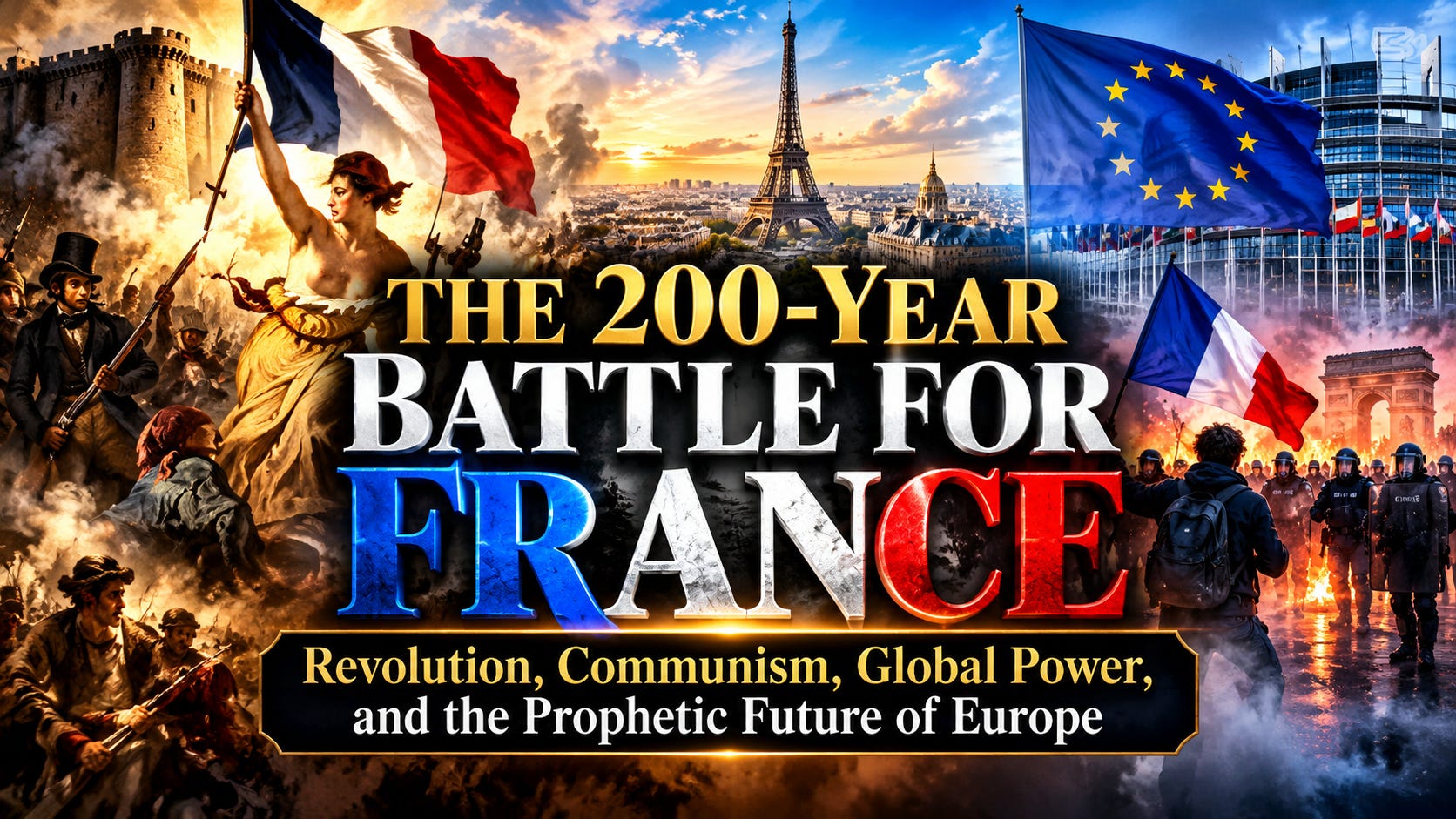
From the French Revolution to the unrest shaking Europe in 2026, a historical investigation explores the ideological forces reshaping Western civilization—and their implications for biblical prophecy.

🎉📖Discover Troy Anderson’s Inspiring Book Collection🎉📖
Prophecy Investigators is a reader-supported publication. If you enjoy our articles and videos, please consider becoming a paid subscriber. You will receive access to read in-depth articles, watch exclusive interviews, and partner in our mission to spread the Good News of Jesus Christ.
More than two centuries after revolutionaries stormed the Bastille and transformed the political landscape of Europe, France is once again confronting burning buildings, shattered storefronts, violent clashes, and deepening political unrest.
On October 17, approximately 550,000 demonstrators took to the streets nationwide, according to French authorities, while labor unions estimated even greater participation. Although most protesters demonstrated peacefully over rising living costs, deteriorating public services, and educational conditions, violent groups attacked businesses, damaged historic buildings, and confronted police.
By October 20, French officials were preparing additional security measures as political tensions continued. Yet beyond the immediate crisis lies a historical question: Why has France repeatedly become a center of revolutionary upheaval, and what can its turbulent past reveal about the ideological, cultural, and spiritual struggles confronting Western civilization today?
In our companion Revelation Watchers report, “EUROPE IN TURMOIL,” we examined the immediate crisis. This investigation follows a deeper historical trail—from the French Revolution and the emergence of communist thought to cultural transformation, European political integration, and the prophetic questions raised by Daniel and Revelation.
As the multi-great-grandson of “Ode to Joy” poet, playwright and philosopher Friedrich von Schiller, whose revolutionary literary works were adopted by members of the French Revolutions, these developments have a deeply personal aspect to me.
n 1792, the French National Assembly granted Schiller honorary citizenship in the French Republic, largely due to the anti-tyrannical and proto-revolutionary republican ideals expressed in his debut play, The Robbers (1781). Ironically, because of wartime chaos and the document being signed by French officials who were later guillotined during the Reign of Terror, the official diploma did not actually reach Schiller until 1798—years after it was issued.
Schiller’s early plays championed human dignity, individual freedom, and an end to political absolutism. While these themes strongly aligned with the core philosophy of the French Revolution (“Liberté, égalité, fraternité”), his works did not directly trigger or inspire the outbreak of the revolution in 1789. Instead, the French revolutionaries adopted him after the fact as a kindred spirit because of his writing. Furthermore, Schiller himself grew deeply disillusioned with the French Revolution once it spiraled into violent bloodshed and terror, later arguing in his essays that true political freedom could only be achieved after society underwent an moral and “aesthetic education.”
THE FRENCH REVOLUTION: WHEN A NATION CHALLENGED ITS FOUNDATIONS
In 1789, France erupted in revolution against a monarchy weakened by financial crisis, social inequality, and growing demands for political reform. The movement proclaimed liberty, equality, and fraternity, ideals that profoundly influenced modern democracy. Yet the revolution also entered a period of extraordinary violence. During the Reign of Terror, revolutionary authorities associated with Maximilien Robespierre ordered mass arrests and executions, while campaigns against established religious institutions challenged France’s longstanding Catholic heritage. Churches were confiscated, clergy persecuted, and traditional religious authority confronted by efforts to reorganize society around revolutionary principles.
The revolution advanced important concepts of citizenship and legal equality, but its most violent phases exposed the dangers of political movements claiming unlimited moral authority. For followers of Jesus Christ, this history raises a question that transcends political ideology: What happens when governments or revolutionary movements place their own vision of society above the dignity, conscience, and freedom of individuals? Proverbs 14:34 reminds believers, “Righteousness exalteth a nation: but sin is a reproach to any people.”
THE FORGOTTEN CONNECTION: BABEUF, COMMUNISM, AND THE PARIS COMMUNE
One of the lesser-known figures emerging from revolutionary France was François-Noël Babeuf, whose 1796 Conspiracy of the Equals advocated radical economic equality and challenged established property arrangements. Although Babeuf was executed, his ideas influenced subsequent socialist and communist thinkers. Decades later, Karl Marx and Friedrich Engels developed their revolutionary theories of class conflict, while the Paris Commune of 1871 became another defining episode in France’s turbulent political history. Established after France’s defeat in the Franco-Prussian War, the Commune attempted to reorganize government and society before ending in bloody confrontation, the destruction of historic buildings, and violent repression by government forces.
These movements differed significantly in their objectives and historical circumstances, but together they reveal how France became an influential arena for debates over political authority, economic equality, private property, and revolutionary change. Their legacy also raises an enduring question: When political institutions lose legitimacy, can societies pursue meaningful reform without descending into ideological extremism or violence?
DISCOVER REVELATION 911 | How does the Book of Revelation intersect with today’s headlines? Join Pastor Paul Begley and Troy Anderson as they explore biblical prophecy, world events, and the extraordinary times in which we live. | Get Your Copy of Revelation 911 on Amazon →
THE CULTURAL BATTLE: FROM GRAMSCI TO THE REVOLUTION OF 1968
By the twentieth century, political struggles increasingly extended beyond elections and armed revolution into universities, media, philosophy, and cultural institutions. Italian Marxist thinker Antonio Gramsci examined how political authority is sustained through cultural influence, education, and accepted social beliefs, developing the concept of cultural hegemony. His ideas later influenced diverse intellectual movements, including claims that he established a coordinated secret campaign to dismantle Western civilization.
France’s May 1968 uprising demonstrated the growing influence of cultural rebellion. Students occupied universities, millions of workers joined strikes, and demonstrators challenged established political and social authority. Some radical factions displayed portraits of Mao Zedong and drew inspiration from China’s Cultural Revolution, while other participants represented very different ideological traditions. The movement eventually subsided, but debates over religion, family, education, morality, and individual freedom continued to reshape French society. For Christians, these developments underscore the importance of Romans 12:2, which calls believers to resist conformity to the world and seek transformation through the renewing of their minds with Christ.
EUROPEAN INTEGRATION: THE STRUGGLE OVER SOVEREIGNTY AND GLOBAL POWER
Following World War II, European nations pursued economic and political integration to encourage cooperation and prevent future conflict, eventually establishing the European Union. Supporters credit European integration with promoting stability and economic opportunity, while critics question whether increasingly powerful supranational institutions have weakened national sovereignty and democratic accountability. France’s 2005 referendum, in which approximately 55 percent of voters rejected the proposed European Constitution, became a defining moment in this debate. Two years later, European leaders signed the Treaty of Lisbon, incorporating several institutional reforms associated with the earlier constitutional project and renewing concerns about the relationship between political elites and ordinary voters.
France’s influential administrative establishment, historically associated with institutions such as the École nationale d’administration, has also generated debate about technocracy and concentrated political influence. Some commentators describe enduring networks of institutional power as a “deep state,” although the existence of elite bureaucracies does not establish a coordinated secret government. Nevertheless, the broader question remains significant: As political and economic authority becomes increasingly interconnected across national boundaries, how can governments preserve accountability, individual freedom, and national self-determination?

DISCOVER THE TRUMP CODE | Could mysteries of the past hold clues to America’s future? In The Trump Code, bestselling author Troy Anderson investigates fascinating connections between Ingersoll Lockwood’s “Baron Trump” novels, biblical prophecy, Nikola Tesla, time travel theories, and Donald Trump’s extraordinary political journey.
Explore the mysteries. Connect the dots. Get Your Copy on Amazon →
WHY FRANCE IS ERUPTING AGAIN IN 2026
France’s latest unrest reflects immediate economic and political grievances rather than a single identifiable ideological cause. Student protests over teacher shortages and deteriorating school conditions expanded into broader demonstrations involving labor organizations and citizens concerned about purchasing power, public services, and government policies. The October 17 demonstrations drew hundreds of thousands of participants, most of whom protested peacefully, while violent groups attacked public buildings, looted businesses, and confronted security forces. French authorities blamed elements of the ultra-left and opportunistic criminals for some disturbances, but allegations of centralized foreign direction or a unified international revolutionary conspiracy have not been substantiated.
The upheaval recalls the Yellow Vest movement that began in 2018, when protests against fuel taxes evolved into a broader challenge to government economic policy. Although the circumstances differ, both episodes reveal how economic pressure, political distrust, and social polarization can combine into national crises. France’s revolutionary history provides valuable context, but historical parallels alone cannot establish that today’s demonstrators are participating in a continuous revolutionary movement extending back to 1789.
THE PROPHETIC QUESTION: DANIEL, REVELATION, AND THE TEN KINGS
For students of biblical prophecy, the concentration of political authority raises questions about the visions recorded in Daniel and Revelation. Daniel 2 describes successive kingdoms represented by a great statue, while Daniel 7 portrays powerful beasts and ten horns associated with kings. Revelation 17:12–13 similarly describes ten kings who receive authority and ultimately surrender their power to the beast: “These have one mind, and shall give their power and strength unto the beast.”
Bible scholars understand these passages as describing a future coalition of rulers who will support an end-times world leader. Other theological traditions interpret the imagery in relation to ancient empires or recurring patterns of oppressive political power. The Bible does not specifically identify the modern European Union, France, or any existing international institution as the Ten Kings. Nevertheless, these passages invite serious reflection on the dangers of unchecked authority, political allegiance, and the potential misuse of increasingly sophisticated systems of government and economic control.
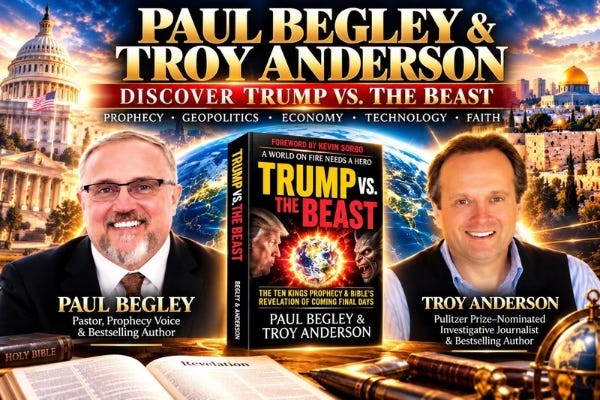
TRUMP VS. THE BEAST: The Ten Kings Prophecy and the Bible’s Revelation of Coming Final Days | By Pastor Paul Begley and Troy Anderson
FROM THE FRENCH REVOLUTION TO THE TEN KINGS: WHY TRUMP VS. THE BEAST MATTERS NOW
As Europe confronts political instability and debates over sovereignty, our newly released book explores the relationship between global power, emerging technologies, and biblical prophecy. Published October 6, 2026, by Humanix Books/Newsmax Media, Trump vs. the Beast, by myself (bestselling investigative journalist Troy Anderson) and Pastor Paul Begley, features forewords by Kevin Sorbo and Joseph Z. The book examines the Ten Kings prophecy, the Antichrist, artificial intelligence, economic systems, and the possibility of unprecedented concentrations of political and technological authority.
The historical struggles explored in this investigation do not establish that France’s unrest fulfills biblical prophecy or that Europe’s institutions represent the final prophetic kingdom. Yet they illustrate why the questions examined in Trump vs. the Beast, the #1 “Best Seller” and #1 “Hot New Release” in “Prophecies” on Amazon, remain timely: How might political authority become concentrated across national boundaries? Could advanced technologies enable new forms of economic control? And how should Christians interpret these developments while remaining grounded in Scripture rather than speculation? Building upon themes explored in our earlier bestseller, Revelation 911, the book invites readers to examine current events through a futurist biblical perspective.
DISCOVER TRUMP VS. THE BEAST ON AMAZON
A FINAL WARNING—AND THE HOPE OF CHRIST’S KINGDOM
From the French Revolution and the Paris Commune to the cultural upheavals of 1968 and the unrest of October 2026, France’s history reveals recurring struggles over political legitimacy, ideological change, and the relationship between citizens and governing institutions. These events arose from different circumstances, but they remind us that civilizations face serious challenges when public trust erodes, social divisions deepen, and political conflict overwhelms peaceful reform.
For Christians, the ultimate response is not fear but discernment, prayer, and faithfulness to Jesus Christ. Daniel 2:21 reminds believers that God “removeth kings, and setteth up kings,” while Revelation 11:15 proclaims that the kingdoms of this world will ultimately become the Kingdom of our Lord and His Christ. Whatever political changes lie ahead, the central message of biblical prophecy remains one of divine sovereignty and enduring hope.
The political future of Europe remains uncertain. The promise of Christ’s Kingdom does not.
A PRAYER FOR FRANCE AND THE NATIONS
Heavenly Father, we lift up France, Europe, and the nations experiencing political turmoil, economic hardship, and division. Protect the innocent, comfort those who are suffering, and grant wisdom to leaders confronting difficult decisions. Strengthen Your Church to proclaim the Gospel with courage, compassion, and truth. Give us discernment to recognize deception, reject hatred, and remain faithful to Your Word. May many turn to Jesus Christ for forgiveness, salvation, and everlasting hope. In Jesus’ mighty name, Amen.
Media & Interview Inquiries
Pastor Paul Begley and Troy Anderson, coauthors of Trump vs. the Beast, are available for television, radio, podcast, print, and digital interviews exploring biblical prophecy, the Ten Kings, global political developments, artificial intelligence, and the growing intersection of faith, technology, and world events.
Media Contact: Inspire PR Agency
Troy Anderson
Pulitzer Prize–Nominated Investigative Journalist
Seven-Time #1 Bestselling Author | Founder, Inspire Literary Group
Email: troyanderson.writer@gmail.com
Phone: 949-887-1511
VISIT TROY ANDERSON’S OFFICIAL WEBSITE →

Have a Story or Message That Belongs in a Book?
Every extraordinary story deserves to be told. Whether you have a powerful testimony, groundbreaking research, a lifetime of experiences, or a message that could inspire others, Inspire Literary Group helps aspiring and established authors transform their ideas into compelling books.
Led by bestselling author and investigative journalist Troy Anderson, Inspire Literary Group provides professional ghostwriting, editing, book proposal development, publishing guidance, and personalized author support—from concept to publication.
Your story could become a book that informs, inspires, and impacts generations.
For a complimentary consultation, contact Troy Anderson, Founder and President of Inspire Literary Group.
Email: troyanderson@inspireliterary.com
Phone: 949-887-1511
Books Change Lives. Yours Could Be Next.
EXPLORE INSPIRE LITERARY GROUP →
Sources
Current News Reporting
Reuters — Macron Urges Calm as France Counts Cost of Worst Unrest in Years (October 18, 2026)
Reuters — France to Deploy Troops, Admits to Failures Over Weekend Unrest (October 20, 2026)
Historical Research and Background
Related Coverage
Editorial Disclosure: Troy Anderson, founder and editor-in-chief of Prophecy Investigators, is a coauthor of Trump vs. the Beast and Revelation 911, both featured in this article. The publication examines world events through investigative journalism, biblical prophecy, and Christian perspectives.
Editor’s Note: Historical reporting is distinguished from theological interpretations and prophetic speculation. References to the Beast, Ten Kings, and global political systems do not establish the fulfillment of biblical prophecy.