

From the golden head of Babylon to the mysterious kingdom of iron and clay, an investigation into Daniel’s visions, the empires of antiquity, and the promise of a kingdom that will never be destroyed.

🎉📖Discover Troy Anderson’s Inspiring Book Collection🎉📖
Prophecy Investigators is a reader-supported publication. If you enjoy our articles and videos, please consider becoming a paid subscriber. You will receive access to read in-depth articles, watch exclusive interviews, and partner in our mission to spread the Good News of Jesus Christ.
THE PROPHECY FILES — FILE 01 | PREMIUM INVESTIGATION
The Dream That Challenged the World’s Most Powerful King
According to the Book of Daniel, during the reign of Nebuchadnezzar II in the sixth century BC, a troubling dream disturbed the sleep of one of the ancient world’s most powerful rulers. From his magnificent capital in Babylon, Nebuchadnezzar governed the Neo-Babylonian Empire, whose military conquests had reshaped the political landscape of the ancient Near East. Jerusalem had fallen under Babylonian domination, and members of Judah’s population had been carried into exile. Among them was Daniel, a young Hebrew whose remarkable story would become inseparable from one of the most extraordinary and debated prophetic visions in Scripture.
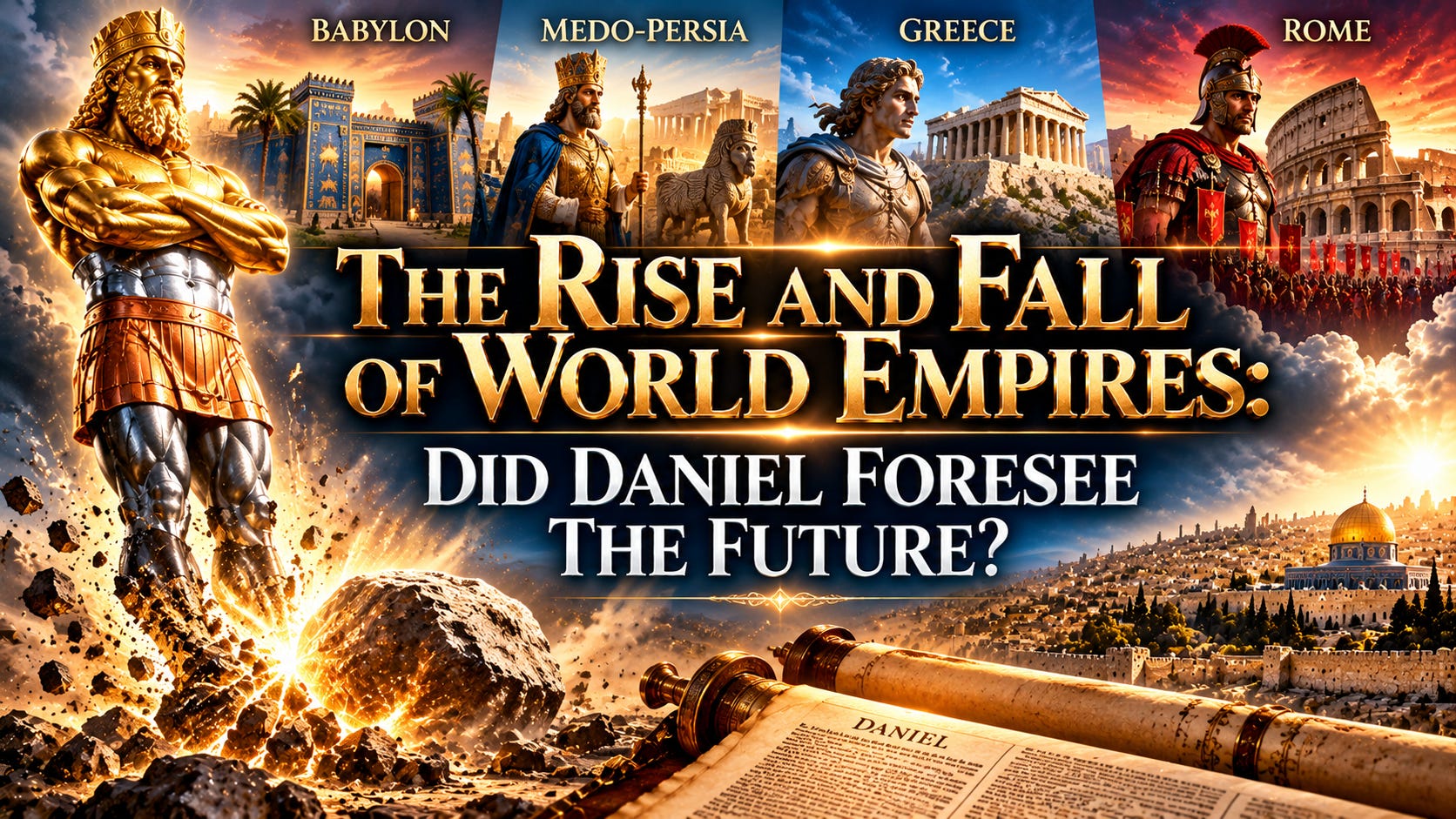
The king’s dream revealed a towering statue of dazzling appearance, its head made of gold, its chest and arms of silver, its belly and thighs of brass, its legs of iron, and its feet composed partly of iron and partly of clay. Then something astonishing happened. A stone, cut without human hands, struck the statue’s feet, shattering the entire structure. The metals crumbled and were swept away like chaff in the wind, while the stone grew into a great mountain that filled the whole earth. What appeared to be a mysterious royal dream would become, in Daniel’s interpretation, a sweeping vision of the rise and fall of earthly kingdoms and the ultimate establishment of a kingdom that would never be destroyed.
Daniel 2:44 (KJV)
“And in the days of these kings shall the God of heaven set up a kingdom, which shall never be destroyed: and the kingdom shall not be left to other people, but it shall break in pieces and consume all these kingdoms, and it shall stand for ever.”
For centuries, theologians, historians, and biblical scholars have debated the identities of the kingdoms represented by the statue. Many traditional Christian interpreters have understood the sequence as Babylon, Medo-Persia, Greece, and Rome. Other scholars argue that the four kingdoms represent Babylon, Media, Persia, and the Greek kingdoms that emerged following the conquests of Alexander the Great. These competing interpretations raise profound questions about the historical setting of Daniel’s visions, the dating of the biblical text, and the relationship between ancient prophecy and the unfolding events of world history.
The distinction is consequential. It influences whether Daniel’s vision is understood primarily as a message concerning the empires of antiquity, a prophetic revelation extending into the Roman period, or a vision that also anticipates a future world kingdom. At the heart of the debate lies a question that has fascinated generations of believers and scholars alike: Did Daniel foresee the future, and what evidence can history provide?
In this first installment of The Prophecy Files, we investigate the ancient biblical text, the historical rise and fall of the world’s great empires, the competing interpretations of Daniel’s extraordinary visions, and the remarkable promise at the center of the prophecy. Through Scripture, historical research, and careful examination of the evidence, we seek to understand what Daniel’s visions revealed to their original audience and why their message continues to resonate more than two millennia later.
The investigation begins with the golden head of Babylon.
Support Our Mission: Help Prophecy Investigators uncover the truth, investigate biblical prophecy, and explore the forces shaping our world. Become a paid subscriber and support independent journalism rooted in truth, discernment, and faith.